


Which wrist wins: full-on Apple power or nimble Fitbit endurance? Spoiler — both have a case.
You don’t need a gym membership to be impressive — just the right wrist tech. Imagine nailing a PR, tracking recovery like a coach, and still making it to dinner with battery left. That’s the promise of modern fitness trackers.
Small, smart, and a little bit nerdy. These five contenders cover premium displays and deep health sensors to featherweight, all-day comfort. Quick picks if you want the short version: Apple Watch Series 10 for power; Fitbit Charge 6 for long battery + Google smarts.
Top Picks
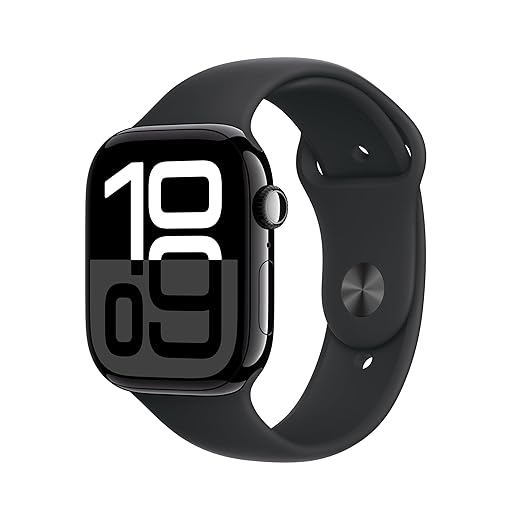


Apple Watch Series 10 GPS 46mm Case
A top-tier smartwatch with an expanded, bright display, advanced health sensors and tight Apple ecosystem integration. It delivers deep fitness insights, fast charging and safety features that make it a powerful everyday health and lifestyle device.
Premium hardware with comprehensive health tools
The Series 10 is Apple’s most capable mainstream smartwatch for fitness and health monitoring. It pairs a larger, more readable display with advanced sensors that capture ECG, SpO2 and additional overnight vitals. The result is a device built for users who want in-depth, on-wrist health intelligence and real-time safety features.
Practical fitness and daily benefits
Users report that the improved display and faster performance make fitness tracking and on-the-go interactions feel snappier. The rich set of metrics is particularly useful for runners and athletes who want immediate feedback plus long-term trend tracking.
Limitations and who should consider it
For anyone who wants a premium, do-it-all device with deep fitness and safety features and seamless Apple integration, the Series 10 is one of the strongest options on the market.
Fitbit Charge 6 Google-Integrated Tracker
A compelling midweight fitness tracker that brings Google apps to a compact wrist UI while keeping robust health sensors and multi-day battery life. It’s an excellent pick for users who want smart features plus reliable fitness tracking without a full smartwatch footprint.
What it does best
The Charge 6 bridges the gap between a smart tracker and a compact smartwatch by integrating select Google services directly on the tracker. That means turn-by-turn directions, contactless payments, and music controls on a device that still prioritizes fitness and battery life.
Standout hardware and sensors
Battery performance lets many users get through multiple days between charges, which is a clear advantage over many smartwatch alternatives. The inclusion of Google Maps and Wallet on a tracker simplifies training sessions and urban runs without needing to carry a phone for navigation.
Practical considerations and user-reported quirks
Who will benefit most
If you want a tracker that doubles as a lightweight Google-enabled device—while keeping reliable fitness metrics and multi-day battery—this model is among the best choices. Power users who depend on flawless ecosystem sync or who need every advanced metric to be clinically precise should test specific workflows before committing.
Apple Watch SE (2nd Gen) GPS 40mm
A value-focused Apple Watch that delivers the essentials—fitness tracking, safety features and smooth watchOS performance—at a lower price. It’s an excellent choice for iPhone users who want core smartwatch and health features without premium extras.
Value-first smartwatch with solid core features
The second-generation Apple Watch SE distills what most people use daily—notifications, activity tracking, safety alerts and a refined watchOS experience—into a more affordable package. It keeps the smooth Apple software experience while removing a few premium sensors to hit a better price point.
What you get and practical advantages
For many users, the SE represents the best balance between cost and capability—strong enough for reliable fitness tracking and smart notifications, without the premium price tag of Apple’s top-tier models.
Tradeoffs to consider
Fitbit Versa 4 Daily Readiness Smartwatch
A balanced fitness smartwatch that focuses on training results with Daily Readiness scores, built-in GPS and a broad library of exercise modes. It’s aimed at users who want actionable recovery guidance paired with on-wrist coaching and decent battery life.
Fitness-first smartwatch with recovery insights
The Versa 4 positions itself as a coach on the wrist: it offers Daily Readiness Scores that tell you whether to push a hard session or opt for recovery. That signal, combined with built-in GPS and Active Zone Minutes, helps structure training in a clear, actionable way.
Key features and how they help you train
Users who shifted from basic trackers frequently praised the Versa 4 for helping them avoid overtraining and for providing immediate training context right after workouts. The fast-charge capability is handy for short top-ups ahead of an evening session.
Limitations and buyer tips
Fitbit Inspire 3 Slim Health Tracker
A compact, comfort-first tracker that focuses on core health metrics and long battery life. It’s ideal for users who want reliable sleep, stress and heart-rate monitoring without a heavy smartwatch experience.
Purpose and positioning
The Inspire 3 is Fitbit’s compact, affordability-first fitness tracker designed for people who want continuous health monitoring without the bulk or battery drain of a full smartwatch. It targets users who prioritize sleep, stress and baseline health metrics and prefer a device they can forget on their wrist all day.
Key features and benefit highlights
These combine to give a clear picture of daily recovery and readiness; for example, the Daily Readiness Score helps people decide whether to push a hard workout or plan a recovery day.
Real-world use, limitations and practical insights
Who should buy it
If your priority is comfortable 24/7 health monitoring, accurate sleep/stress tracking, and long battery life at a wallet-friendly price, this tracker is an efficient choice. If you want advanced smart features (apps, large on-wrist interactions, cellular), consider a fuller smartwatch instead.
Final Thoughts
Pick the Apple Watch Series 10 GPS 46mm Case if you want the most comprehensive, premium experience and you use an iPhone. Strengths: large bright display, advanced health sensors, fast charging, and seamless Apple ecosystem integration. Ideal for: athletes who want granular metrics, safety features, and smartwatch apps.
Choose the Fitbit Charge 6 Google-Integrated Tracker if you want a compact device with excellent battery life and Google integration (great for Android users). Strengths: multi-day battery, solid sensors in a slim package, and on-wrist access to Google features. Ideal for: people who want reliable fitness tracking without the full smartwatch footprint or daily charging.
How to Choose, Use, and Care for Your Fitness Tracker
Quick buying checklist
Tips & tricks for real-world use
Product care and longevity
Use cases and workflows
Common mistakes to avoid
Budget vs. premium — where to spend
Final note: the best tracker is the one you actually wear. Match features to your daily habits, not the headline specs, and you’ll get the most useful data and the longest enjoyment out of your device.
FAQ
Yes. The Apple Watch Series 10 and Apple Watch SE integrate tightly with iPhone features like iMessage, Apple Fitness+, and iCloud health syncing. If you want the smoothest experience and the full feature set, pair an Apple Watch with an iPhone.
Battery varies by model and usage. Expect the Apple Watch Series 10 to need daily charging with heavy use (though it has fast charging), while the Fitbit Charge 6 and Inspire 3 typically deliver multiple days. Versa 4 sits between a full smartwatch and slim tracker — usually a couple days under normal use.
They’re very good for trends and daily monitoring. All five models use optical heart-rate sensors and provide reliable trend data, but chest straps or clinical-grade devices remain best for minute-by-minute, lab-level accuracy. For sleep, Fitbit devices have a long track record for sensible staging, while Apple focuses on simplicity and integration.
Yes, if the device has built-in GPS. The Apple Watch Series 10 and Fitbit Versa 4 include on-device GPS for phone-free runs. The Charge 6 also offers GPS while staying compact. The Inspire 3 may rely more on connected GPS depending on settings; check the model’s specs before long solo trails.
Most modern trackers are water resistant and handle sweat and showers just fine. Avoid exposing leather bands to saltwater and high-pressure streams. Rinse silicone bands after heavy sweating or saltwater and dry them before re-wearing.
Yes — if you want actionable recovery guidance. Fitbit’s Daily Readiness (on Versa 4) combines activity, sleep, and HRV/strain cues into a simple score so you can decide between a hard workout or an easy recovery day. Use it to prevent overtraining and plan better weekly loads.


I have a weird use case: swimming laps daily. Which device here has the best waterproofing and lap tracking accuracy? The article says Apple Series 10 is water resistant, but does Fitbit handle pools well?
Make sure to rinse the band after chlorine exposure — that saved my devices.
I swim with my Versa 4 and it tracks laps fine. For open-water GPS swims, Apple might be more accurate.
Both Apple Watch Series 10 and many Fitbits (Versa 4, Inspire 3) offer swim tracking and are water resistant suitable for pools. Apple tends to have more robust open-water and pool features, but Versa 4 is reliable for lap counting and provides good metrics. Check depth/water resistance specs for diving (neither is suitable for deep diving).
Okay serious question: skin irritation. Anyone with sensitive skin had problems with Fitbit bands (Inspire 3/Charge 6) vs Apple sport bands? I get rashes and want to avoid that.
I use hypoallergenic third-party bands and rotate them; no more rashes. Also, loosen it slightly during workouts so sweat can evaporate.
Switch to the woven nylon or fabric loops — I had rashes from cheap silicone and fabric helped. Also wash the band weekly.
Skin reactions can be caused by sweat, band material, or detergents. Many users with sensitivities prefer silicone or woven nylon bands and cleaning their bands regularly. If you have nickel allergy, ensure metal buckles are hypoallergenic.
Short and sweet: The Fitbit Inspire 3 is so light I forget I’m wearing it. For steps/sleep/stress management it’s been flawless. Not into apps, so the simplicity is great.
Agreed. I wear mine to sleep every night and it doesn’t bother me at all. Battery lasts ages too.
That’s exactly the Inspire 3’s strength—comfort and core health metrics. Great pick if you want low fuss and long battery life.
Loved the rundown — pretty thorough. I’m an iPhone user and was leaning toward the Apple Watch Series 10 for the ECG and bigger screen.
Question: has anyone noticed battery life differences between the Series 10 and the SE (2nd Gen) during heavy workout days? I don’t want daily charging.
I have both (weird flex) — Series 10 lasts about a day with GPS runs and music streaming; SE can squeak out closer to 1.5 days if you don’t use the always-on screen. YMMV.
Good question, Sarah. The Series 10 has more features and a brighter display, which can reduce battery life compared with the SE. For heavy workout + always-on display usage expect shorter runtimes—usually a day with intensive GPS sessions. Turning off always-on and optimizing background apps helps.
Anyone compared Versa 4 vs Charge 6 for workout tracking? I do HIIT and cycling, want accurate heart rate and recovery insights. The article praises Versa 4’s Daily Readiness—is it worth the upgrade over Charge?
For HIIT I preferred Versa 4 — the HR tracking seemed more responsive during sprints. But Charge 6 gave me longer battery life for multi-day events.
If you want one device for workouts + lower fuss daily wear, Versa 4 is a nice middle ground. But if you hate charging, Charge 6 wins.
Versa 4 leans more into training guidance (Daily Readiness, on-wrist coaching) and has a bigger screen for quick glance metrics. Charge 6 is more compact with Google integration and great battery. For serious recovery insights and larger display, Versa 4 may be preferable.
I bought the Fitbit Charge 6 last month. Definitely impressed with the GPS and battery; the Google apps are handy. The only gripe is the sleep tracker seems to mislabel naps occasionally. Anyone else see that?
Thanks for sharing, Jason. Some users have reported sporadic nap detection issues with Fitbit—try updating the firmware and checking the sleep sensitivity settings. If it persists, Fitbit support can sometimes reset your sleep data calibration.
Yep, mine did that during travel. A restart and a firmware update fixed it for a week, then it came back. I think it’s still a software quirk.
Got the Apple Watch SE (2nd Gen) as a budget Apple option and it’s been solid. Crash detection saved me an ER visit once (wild!), so the safety features alone are worth it for me.
Also, watch bands: any recommendations for comfy bands for long runs?
Sport loop here — light and dries fast. Avoid leather during sweaty workouts (duh), but if you want style after the run, swap to leather then.
So glad the SE’s safety features helped you, Emily. For long runs many recommend the sport loop for breathability or braided solo loop for snug comfort without pinching.
Check out third-party silicone straps on Amazon — cheap and comfy. Just make sure they have good reviews for fit and skin reaction.
Full disclosure: I’m biased toward Apple but the article made me consider the Fitbit Versa 4 for its Daily Readiness feature. Been curious whether that actually helps prevent overtraining or is it just motivational fluff?
It’s practical for me — on days my score is low I do lighter workouts and feel better. Helps with consistency, not magic.
Daily Readiness synthesizes HRV, sleep, and recent activity to suggest readiness. It’s a useful guideline rather than a strict rule—great for people who want structured recovery insight. Not perfect, but actionable for most users.
I ignored it for a month, then used it and noticed fewer burnout weeks. Worth trying.
Longish thought —
I switched from a bulky older smartwatch to the Inspire 3 because I wanted mindfulness/stress features and better sleep tracking. The change forced me to be less screen-obsessed and oddly boosted my consistency in workouts.
If you want less tech noise but solid health data, Inspire 3 is underrated.
Totally — I did the same and now I actually go for runs instead of fiddling with apps mid-run. The Inspire 3 is low-key but effective.
Thanks for sharing, Zoe — that’s a great perspective. Sometimes a lighter device better supports behavior change by reducing distractions.
Small rant: I love Apple Watch features but the price makes me twitch. The SE is tempting, but does it still support all essential health tracking compared to Series 10? Like ECG?
The SE (2nd Gen) does not include ECG or some of the advanced sensors found in the Series 10. It covers core health metrics (heart rate, activity, sleep basics) and safety features, but not advanced ECG/oximeter readings.
If you need ECG specifically, Series 10 (or higher-end model) is required. Otherwise SE gives great value for general tracking.