

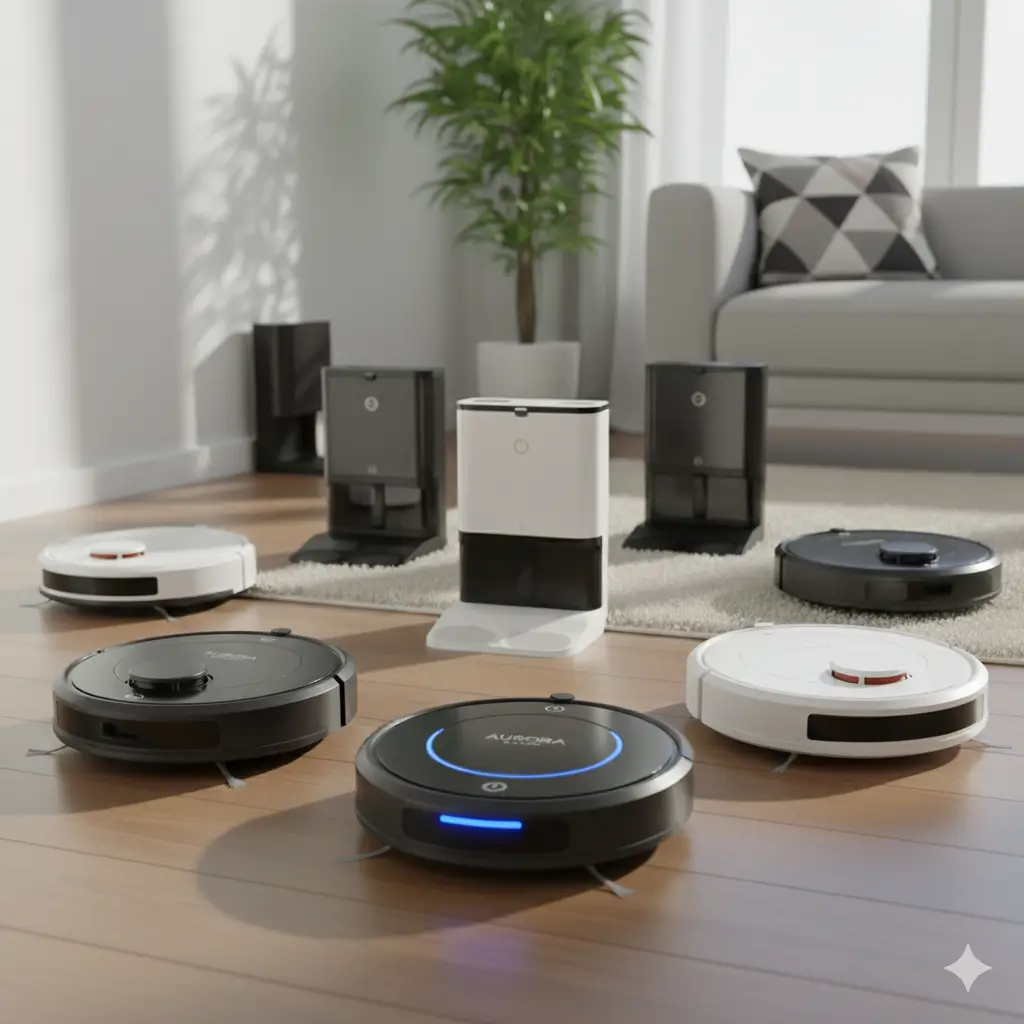
Can a robot finally win the battle against pet hair, dust bunnies, and your busy schedule?
Tired of vacuuming? Let AI handle it. These new Shark robot vacuums map smarter, clean deeper, and some even empty themselves—so you can stop scheduling chores around nap time.
Modern models combine precise navigation, sonic mopping, and HEPA filtration into compact robots. They won’t replace deep cleaning entirely, but they cut down daily mess and save serious time.
Top Picks


A premium AI model with Matrix Clean navigation and a large HEPA self‑empty base that minimizes day‑to‑day maintenance. Excellent suction and HEPA filtration make it a strong choice for allergy households and multi‑room cleaning.
Overview
The RV2502AE is Shark's higher‑end AI Ultra robot with Matrix Clean Navigation and an XL HEPA self‑empty base. It targets buyers who want minimal interaction: set schedules, let the robot run, and empty the base only every few weeks. HEPA filtration adds value for allergy sufferers by trapping fine particles in the base.
What sets it apart
Owners with high‑traffic or pet households find the autonomy and filtration combination reduces the hands‑on cleaning time dramatically.
Tradeoffs and considerations
If you want a set‑and‑forget machine with strong filtration and edge cleaning, this model is among the most complete Shark offers.
Practical tips
Keep the base area clear and follow filter cleaning recommendations. For homes with heavy shedding, empty the base on a slightly more frequent schedule until you find your sweet spot between convenience and performance.
Matrix Clean plus Sonic Mopping and CleanEdge technology give this model strong cleaning coverage, including better edge pickup than many competitors. It balances vacuum power and mop capability for homes that need both functions regularly.
Overview
The RV2620WD brings Shark's Matrix Clean navigation together with sonic mopping and CleanEdge technology, aiming to reduce missed spots and improve edge performance. It's a feature‑rich 2‑in‑1 designed for households that need both thorough carpet cleaning and occasional mopping in a single device.
Strengths and real-world benefits
Users who run the robot regularly appreciate how the combined systems reduce manual spot cleaning and improve overall floor appearance.
Known limitations
Who benefits most
This model fits buyers who want high cleaning performance across floor types and can commit to light maintenance of the mop system. If edge and deep cleaning are priorities, the RV2620WD delivers a compelling mix of features.
A solid mid‑to‑high range self‑emptying robot that balances suction, mapping accuracy, and a compact self‑empty base capacity (30 days). It’s a convenient option for busy homes that want hands‑off maintenance without flagship pricing.
Overview
The UR2500SR is Shark's AI Ultra with a 30‑day bagless self‑empty base designed for users who want convenience without a very large base footprint. It uses LIDAR mapping for night or day operation and offers the familiar Shark combination of suction and self‑cleaning brush technology.
Practical advantages
Owners frequently highlight how much time the robot saves daily, especially in multi‑pet homes where fur accumulates quickly.
Caveats and real‑world tips
Final thought
If you want the convenience of a self‑empty robot without the highest price tag, the UR2500SR offers a strong balance of autonomy, cleaning power, and mapping intelligence for most family homes.
Excellent suction and a self-cleaning brushroll make it a strong day-to-day cleaner for homes with pets. LIDAR-based mapping and object detection give consistent, methodical coverage with good app control.
Overview
The AV2001 is Shark's mid‑range AI robot that focuses on reliable vacuuming performance and pet‑friendly cleanup. It combines robust suction, a self‑cleaning PowerFins brushroll, and LIDAR navigation to map your home and clean in methodical rows. The result is repeatable coverage and strong pickup of pet hair on both hard floors and carpets.
What it does well
This behavior makes it easy to schedule frequent runs and rely on the robot for daily upkeep. Many owners report significant reductions in visible pet hair when the robot runs regularly.
Limitations and practical considerations
If you have a lot of loose small items on the floor, pre‑clearing that clutter will give the best results.
Who should consider it
Ideal for households with pets that want a reliable daily maintainer that is better than entry‑level robots but doesn't command flagship pricing. Expect excellent hair pickup, dependable mapping, and a modest learning curve to the app and connectivity.
Consistent LIDAR mapping and logical navigation make this model a dependable daily cleaner. It handles pet hair well but has a smaller dust bin and moderate battery runtime that may require shorter zone cleans in larger homes.
Overview
The RV2001 delivers core Shark AI features — LIDAR mapping, logical row‑by‑row navigation, and a self‑cleaning brushroll — at a price point aimed at users who want intelligent mapping without flagship cost. It's positioned as a robust everyday vacuum that reduces manual sweeping and keeps high‑traffic areas consistently tidy.
Strengths in everyday use
Owners frequently note that the RV2001 makes maintaining a clean floor much easier, even if it doesn't replace a periodic deep clean with a full‑size vacuum.
Tradeoffs and tips
Tip: split larger homes into zones in the app and run the robot room‑by‑room if battery runtime is a concern.
Who this is for
Ideal for value‑minded shoppers who want LIDAR navigation and good hair pickup without paying top‑tier prices. Works best in medium‑sized homes where you can run targeted cleans.
Combines vacuum suction with sonic mopping to address sticky spots and everyday soil on hard floors. The vacuum side performs well, but the mopping system can be inconsistent and requires careful maintenance and the right cleaning solution.
Overview
The AV2001WD adds Sonic Mopping to Shark's AI vacuum platform so the robot vacuums and scrubs hard floors in the same run. The sonic pad claims 100 scrubs per minute to help lift stuck‑on grime while the robot's LIDAR navigation maps your rooms for targeted cleaning. In theory this makes it a sensible all‑in‑one option for busy households.
Key features and benefits
For homes with lots of tile or sealed wood, the unit can reduce the need for manual floor mopping between deep cleans.
Limitations and user realities
If your priority is reliable, hands‑off mopping without babysitting, be prepared for occasional troubleshooting and maintenance.
Buying considerations
This model is a good fit if you want one robot to both vacuum and mop but are aware the mop feature is not perfect. Expect great vacuum performance and useful mopping for light‑to‑moderate messes, but plan to maintain the reservoir and pads and check maps periodically.
Offers combined vacuuming and sonic mopping with precision mapping, making it attractive on paper for mixed floor homes. In practice the vacuum performs well, while the mop occasionally shows inconsistent behavior and requires active maintenance.
Overview
The RV2001WD is Shark's Pro VacMop variant that brings vacuuming and sonic mopping together with LiDAR navigation. It is designed to clean hard floors and avoid carpets automatically, while offering app controls for zoning and scheduling.
Key strengths
Many users appreciate the convenience of combined cleaning when it works as intended, especially for quick maintenance between deep cleans.
Known issues and maintenance
If you prioritize hands‑off mopping with perfect reliability, this model may need some patience; if you accept occasional oversight, it reduces manual effort significantly.
Practical advice
For best results, use the recommended cleaning solution, clean the reservoir regularly, and test mapping runs room by room until the robot learns the layout. That reduces the risk of odd mop behavior and improves overall performance.
Final Thoughts
Top pick: Shark RV2502AE AI Ultra Self-Empty — Best for large homes and allergy sufferers
Runner-up: Shark RV2620WD AI Ultra Vacuum and Mop — Best for deep cleaning and edge reach
Quick note: If pet hair is your top concern, the AV2001 (Vacuum for Pets) is a strong specialized alternative thanks to a self-cleaning brushroll and precise mapping.
Related posts:


 Shark RV2502AE AI Ultra Robot Vacuum – Pet Hair’s Worst Enemy

 Inside Self-Emptying Robot Vacuums: What They Do and Why It Matters


Great roundup — thanks for putting this together!
I’m leaning toward the Shark RV2502AE (self-emptying + HEPA) because we have a couple of allergy sufferers at home. Two quick questions:
1) How easy is it to replace the HEPA filter and the self-empty bags? Are replacements easy to find on Amazon?
2) Does anyone know the expected cost-per-year for consumables (filters, bags)?
Appreciate any real-world numbers — product pages rarely spell out the ongoing cost.
Tip: set calendar reminders to change the HEPA and check the brushroll. Filters lose efficiency slowly — don’t wait until you notice a smell. I save money by buying refills in bulk during sales.
Good questions, Sophie — glad the guide helped. The RV2502AE uses a standard Shark HEPA filter that snaps in (no tools). Replacement filters and bags are readily available on Amazon as OEM and compatible options. As a rough estimate: filters every 6–12 months (~$10–20) and self-empty bags depending on model size (~$10–30 for multi-packs) — so plan on roughly $30–80/year depending on frequency and whether you buy OEM or third‑party.
Picked up the AV2001WD because the sonic mopping sounded great, but I’m honestly disappointed — the mop leaves streaks and sometimes doesn’t even wet the pad properly. Maybe I’m using the wrong solution? Anyone else have this issue?
Sorry you’re seeing streaking, Marcus. A few things to try: use only the recommended dilution (some concentrated cleaners can leave residue), replace the mop pad if it’s worn, and run a shorter mop pass to avoid over-wetting. Also check the nozzle for mineral buildup if you use hard water.
Yes! I had streaks too. Switching to distilled water + a tiny splash of mild floor cleaner helped. Also run the mop on the ‘gentle’ setting for hardwood.
Short take: RV2001 is reliable and doesn’t break the bank. Good mapping and steady cleanup. Not flashy, but does the job.
Thanks for chiming in, Noah. RV2001 is often a great value pick for everyday cleaning without too many bells and whistles.
Agreed. Bought one for my parents and they love it — simple app, low fuss.
Long post: I have a two-dog household and switched to the Shark AV2001 because of the self-cleaning brushroll. The number one selling point for me was that I spend far less time pulling hair out of rollers. Pros:
– Self-cleaning brushroll actually does remove hair from the roller (not perfect but way better than manual models).
– LIDAR mapping reduces repeat passes in the same spot.
– App scheduling is stable.
Cons:
– Mopping isn’t amazing (if you expect a deep mop, it’s not that), and you should still occasionally deep-clean floors manually.
– If your pets shed A LOT, you’ll still be emptying the base more often during heavy-shed months.
Overall: if your priority is minimal hair maintenance and reliable navigation, AV2001 is worth it. Anyone else with heavy shedders confirm?
Sofia — haha. I check the brushroll once a month and give it a quick rinse if needed. Big clumps I snip out. Much less than before, though!
Do you ever have the robot puke up hairballs from the base? Kidding — but seriously, how often do you deep-clean the brushroll?
Yup — double-dog household here too. AV2001 saved me HOURS each month. Still clear tangles from the edges but overall massive time-saver.
Thanks for the detailed rundown, Maya — very helpful. For heavy shedders: the self-cleaning brushroll reduces maintenance significantly but doesn’t eliminate it. Consider pairing the AV2001 with a weekly spot-clean routine during peak shed season.
Trying to decide between the UR2500SR (30-day bagless self-empty) and the RV2502AE (bigger self-empty base). Budget-wise the UR2500SR seems friendlier, but I worry about the mapping/suction difference. Anyone compared these two directly? I live in a ~2,200 sq ft house with both carpet and hardwood.
Also: how important is the base capacity for a house our size? Is 30-day enough or is the larger base worth the extra spend?
Also consider where the base sits — if it’s tucked away, you won’t mind emptying more often. If it’s in a visible spot, the bigger base looks cleaner and empties less.
Good comparison point. UR2500SR is a strong value: compact base and reliable LIDAR mapping. For a 2,200 sq ft home it will usually be fine on a weekly schedule if you run daily spot cleans. RV2502AE’s larger base reduces how often you need to touch it — convenience vs. cost. If you want true hands-off for longer stretches (vacations, busy households), the larger base is worth it; otherwise UR2500SR is a sensible middle ground.
If you have heavy shedding pets, go for the larger base. Otherwise 30 days is usually ok.
I have the UR2500SR and it handles my 1800 sq ft place fine — maps well and suction is solid. I empty the base maybe once every 3–4 weeks when we have guests or heavy shed season.
Thanks everyone — this helps. Leaning UR2500SR unless there’s a sale on the RV2502AE.
Mixed feelings: I love LIDAR mapping — the robot knows the house better than I do now — but battery life on some models worries me. Does anyone know which of these keeps the best runtime under heavy-cleaning mode (carpet + suction boost)? Also, how well do they resume after returning to base?
In heavy or Boost mode, expect shorter runtimes. Generally the higher-end RV2502AE and RV2620WD have better battery management and resume-to-clean well after recharging. UR2500SR performs admirably for its class. All the models with home mapping support resume/return-to-base and continue where they left off, but performance depends on how many obstacles or changes are in the environment.
I run Boost on carpets and normal mode on hardwood. My RV2502AE will return, recharge and finish — very reliable. Battery life depends a lot on suction setting and room size.
Quick tech question: how do these robots handle Alexa routines and multi-room scheduling? Can I set a scheduled clean for just the kitchen every morning, or are schedules limited to whole-home runs?
Most Shark models with app mapping (LIDAR + home mapping) let you create room-specific schedules in the app, and those room jobs can usually be triggered via Alexa routines (run the app scene/cleaning job). So yes — you can schedule a kitchen-only clean for mornings if the model supports room mapping (RV2502AE, UR2500SR, AV2001, RV2620WD, etc.). Double-check the product description for ‘home mapping’ or ‘room cleaning’ support.
I have the RV2620WD and set it to clean the kitchen every day at 9am via the app. Works like a charm with Alexa voice control too.
Heads up: if you change your Wi‑Fi or rename rooms, you may need to resync Alexa scenes. Minor hassle but once set it’s smooth.
We got the SHARK RV2620WD last month for pet hair and it’s been a game-changer. The Matrix Clean navigation is noticeably smarter than our old robot — it actually spends time along baseboards and corners (CleanEdge seems legit).
Pros: picks up tons of fur, maps rooms well, app controls are intuitive. Cons: the mop is more of an occasional helper than a deep-clean tool, and you should empty the small dustbin before long sessions.
If you have dogs and carpets + hardwood, this model is an excellent middle ground. Has anyone tried both the RV2620WD and the AV2001 for pets?
Marta — it’s noticeable but not ear-piercing. I schedule it for lunchtime or when I’m out. On eco mode it’s quite quiet.
How loud is the RV2620WD? My apartment is small and I work from home — curious if it’s tolerable during calls.
I have both in the family home (one for upstairs, one downstairs). RV2620WD handles the stairs area better (edges), AV2001 is slightly better at pulling hair out of high-pile rugs. YMMV.
Thanks for sharing your experience, Evelyn — really useful. For readers: RV2620WD is excellent for mixed-floor homes and edge cleaning. AV2001 has a stronger focus on pet hair with the self-cleaning brushroll, but its mop is less consistent. If pet hair + edge pickup are priorities, RV2620WD is a solid pick.
I’m torn between the AV2001WD (Black/Gold) and the RV2001WD (Black/Silver) — both are hybrid vacuum & mop models with LiDAR. The roundup mentions the AV2001WD’s mopping is inconsistent and the RV2001WD’s mop needs work. Can someone explain the practical differences? I have mostly tile floors but a couple of rugs and want a hybrid that won’t soak my rugs or leave dirt trails.
Also concerned about maintenance — are the mop pads machine-washable and how often should they be replaced?
Good comparison. Short version: AV2001WD has better vacuum performance and a self-cleaning brushroll (better for pet hair); its mopping function is decent for spot-cleaning but not a substitute for a mop. RV2001WD is a hybrid model too but users report more variability in how evenly it applies water and how it handles transitions between floor types.
Mop pads: most are machine-washable (check care instructions), but they can wear out — plan to replace every 6–12 months depending on use. To avoid soaking rugs, use the no-mop zones in the app or set mop-only jobs restricted to specific rooms.
For tiles, I like the sonic mopping on the AV2001WD but agree it’s not flawless. Do a test run and adjust wetness settings before letting it loose on the whole house.
I put a rug strip (virtual boundary) in the app around our area rugs and it never mops them. Works well — no soaked rugs.