What happens when a car won’t start at a critical moment? A dependable jump starter can be the difference between being stranded and being on your way. This article evaluates what makes a jump starter reliable for real-world use, for drivers and professionals, combining lab metrics with field performance to give clear, actionable conclusions.
We focus on measurable standards: chemistry, capacity, peak current, cold-cranking ability, safety, and durability. Rigorous, repeatable testing builds consumer confidence and uncovers hidden weaknesses manufacturers may not disclose. Expect a data-driven examination that balances standardized protocols with hands-on starting tests and practical advice for choosing, operating, and maintaining a jump starter that will actually perform when you need it.
1
Understanding Jump Starter Battery Packs: Types and Use Cases
Amazon.com
5.0
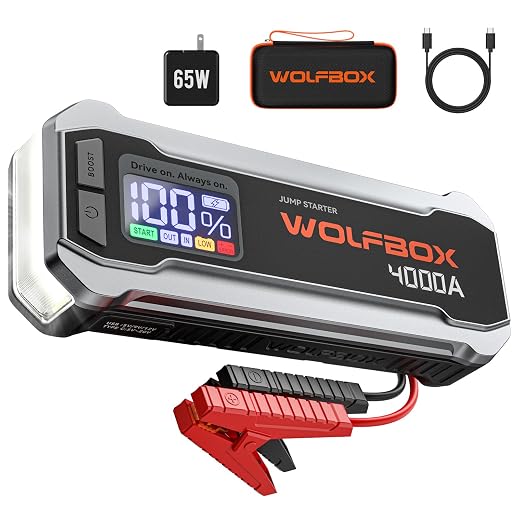
WOLFBOX 4000A Jump Starter,12V Car Battery Jump Starter with 65W Quick Charger,LED Display,24000mAh Portable Jump Starter Battery Pack(10L Gas 10L Diesel...
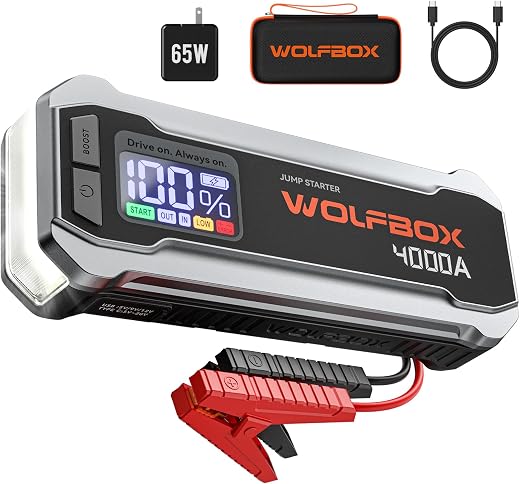
WOLFBOX 4000A Jump Starter with 160PSI Air Compressor, 12V Car Battery Booster, 65W Fast Charge, 24000mAh Portable Tire Inflator, LED Display for 10L Gas &...
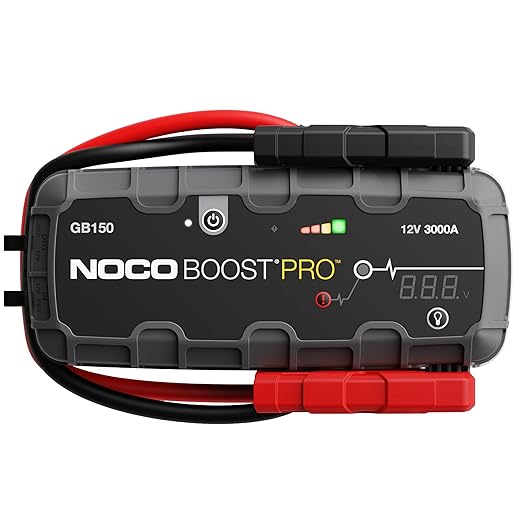
NOCO Boost X GBX45: 1250A UltraSafe Jump Starter – 12V Lithium Battery Booster Pack, Portable Jump Box, Power Bank & Jumper Cables - for 6.5L Gas and 4.0L...
Portable starters come in two dominant chemistries and several form factors. Common chemistries:
Sealed lead‑acid (SLA): inexpensive, proven, heavier, tolerant of abuse but shorter cycle life.
Lithium‑ion (NMC-style): high energy density, very compact, good for occasional roadside use.
Lithium iron phosphate (LiFePO4): lower energy density but superior thermal stability and long cycle life — increasingly common in premium/professional packs.
Form factors range from pocket‑sized “battery bricks” with integrated clamp leads to bulky bench‑style units with heavy cables and built‑in chargers. Which to pick depends on how you plan to use it.
Compact consumer units vs heavy‑duty/professional units
There’s a clear split in design priorities:
Compact consumer units (example: NOCO Boost series): prioritize portability, one‑hand storage, USB power outputs. Great for small‑engine starts and emergency convenience.
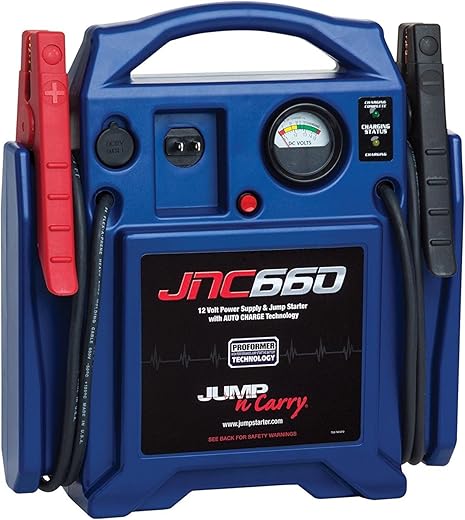
Heavy‑duty/professional units (example: Clore Automotive Jump‑N‑Carry): prioritize raw cranking capability, durability, and repeated use. Typically heavier SLA or large LiFePO4 packs with larger clamps and integrated chargers.
A real‑world note: an urban commuter can keep a pocket‑sized lithium pack in the trunk for a single cold morning start. A tow truck operator needs a high‑capacity pack that can repeatedly crank large diesels.
How use case drives specification priorities
Match vehicle and environment to key specs:
Passenger cars / small SUVs: moderate peak amp (400–800 A) usually sufficient.
Light trucks / V8 gasoline: higher peak amps (800–1,200 A) and larger energy capacity help with multiple starts.
Diesel engines / cold climates: require the highest peak current and robust cold‑cranking performance; heavier packs or dedicated diesel starters are recommended.
Accessory features (USB outputs, LED work lights, air compressors, solar charging) increase utility but add weight/cost and can complicate battery management. Typical user profiles:
Weekend driver/off‑roader: compact LiFePO4 with high peak amps and USB.
Fleet manager/repair shop: heavy‑duty SLA or large LiFePO4 with repeat‑use capability and integrated charger.
Marine operator/emergency prepper: ruggedized, water‑resistant pack with higher capacity and accessory functions.
Next we quantify these choices with standardized test metrics and performance data.
2
Key Performance Metrics and Standardized Test Protocols
A reliable jump starter is defined by repeatable, measurable behavior. Below are the objective metrics to quantify performance and the testing protocols that produce comparable results.
Core metrics to measure
Peak current delivery: short‑term maximum amps under a defined cranking waveform.
Rated vs usable capacity: amp‑hours vs energy actually available under high‑pulse loads.
CCA equivalence: cold‑cranking capability relative to battery CCA ratings.
Internal resistance & voltage sag: dynamic ESR and resulting voltage drop during cranking.
Charge acceptance & recharge time: how fast the unit accepts input charge and returns to ready.
Cycle life & capacity retention: capacity vs number of full/partial cycles.
Self‑discharge: loss of state‑of‑charge over weeks/months at storage temperatures.
Thermal characteristics: surface/internal temps under load and during recharge.
Instrumentation & environment best practices
Use calibrated, high‑precision tools to avoid measurement artifacts:
High‑current shunts or Hall‑effect sensors, stable to ±0.5% for peak current.
Programmable electronic loads and automotive‑grade cranking simulators to reproduce real engine waveforms.
High‑speed data loggers/oscilloscopes for voltage/current traces.
Thermal chambers or cold‑box for temperature conditioning and thermocouples/IR camera for thermal mapping.
Battery cyclers for controlled life‑cycle testing.
Repeatable test protocols
Design tests to reflect real use, not single numbers:
Precondition units: fully charge, then rest 24 hours; record open‑circuit voltage and internal temp.
Cold conditioning: soak at target temperature (0°C, −18°C) for ≥12 hours before cold tests.
Start simulation: apply standardized cranking waveform (duration, duty cycle) rather than constant current; include multi‑start sequences separated by realistic recovery intervals.
Charge/recharge: measure recharge time with typical wall or solar inputs and record charge acceptance curve.
Statistical rigor and reporting
Single‑point runs mislead. Best practice:
Test multiple samples (N≥3 recommended) and perform repeat runs (≥5 starts per sample).
Report mean ± standard deviation and 5th/95th percentile envelopes for peak current and usable energy.
Provide full traces (voltage vs time, current vs time, temperature vs time) and state test temperature and initial SOC.
Real‑world note: compact units (e.g., NOCO Boost series) often show impressive single‑crank peaks but reveal limited usable energy in repeat‑start sequences compared with heavy‑duty packs (e.g., Clore Jump‑N‑Carry) when tested across temperature and multiple starts.
Next we apply these methods to battery chemistry, capacity, and longevity data.
3
Battery Chemistry, Capacity, and Longevity: What the Data Reveals
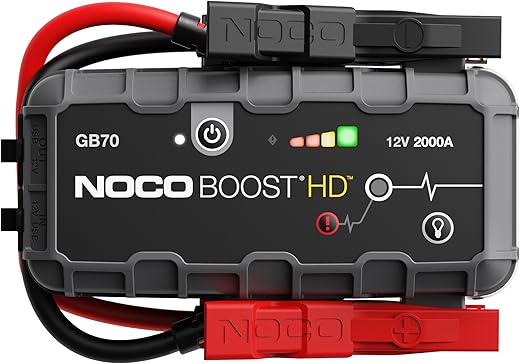
START DEAD BATTERIES — Instantly start dead batteries with 2000 amps of peak lithium power. Up to 40 starts per charge on engines up to 8.0L gas and 6.0L diesel.
ULTRASAFE ...
Different chemistries show distinct practical profiles for jump starters. Quick, data‑driven contrasts:
Lead‑acid (sealed/AGM): high instantaneous power per dollar, poor energy density, low cycle life (typical usable cycles ~200–500), significant Peukert effect (capacity falls at high currents), higher self‑discharge (several %/month).
Li‑ion variants (NMC/NCA): higher energy density, moderate power, cycle life ~500–1,500 cycles, moderate self‑discharge (~2–5%/month), more thermally sensitive.
LiFePO4: lower energy density but excellent cycle life (~1,500–5,000 cycles), low internal resistance (good for pulses), safer thermal profile and low self‑discharge (~1–3%/month).
Example: a compact NOCO Boost (Li‑ion) can deliver high peak amps but may exhaust usable capacity quickly in repeat starts compared with a heavy Clore Jump‑N‑Carry (large lead‑acid) that sustains more repeat cranks at moderate weight.
Usable capacity vs rated capacity under pulse loads
Rated Ah is measured at low discharge rates. Under high C‑rate cranking:
Li‑ion usable capacity typically remains ~70–95% of rated at moderate pulses, depending on chemistry and internal resistance.
Lead‑acid shows larger losses; Peukert exponents (1.1–1.3) can cut usable Ah dramatically at high currents.Practical test tip: request or measure Ah available at the expected cranking C‑rate (e.g., 5–10C) rather than relying on nominal ratings.
Aging mechanisms that matter
Primary drivers of end‑of‑life:
Calendar aging: high SOC and temperature accelerate capacity loss.
Cycle fatigue: deeper DoD and higher C‑rate increase capacity fade per cycle.
Thermal degradation: repeated hot charge/discharge or elevated storage temps cause irreversible changes and increased internal resistance.
Designing life tests & interpreting curves
Best practices:
Use mixed protocols: combine pulse cranking sequences (10–30 s pulses, rest intervals reflecting real starts) with periodic full/partial capacity checks.
Set DoD targets (e.g., 30%, 60%, 80%) and compare capacity retention every 100–250 cycles.
Define end‑of‑life: capacity ≤80% of rated, or inability to deliver required peak current.
Interpret capacity‑retention curves by noting knee points (accelerated fade) and increased ESR — these forecast service life more reliably than cycle counts alone. Next, we apply internal resistance and these findings to real‑world peak current and cold‑cranking tests.
4
Peak Current, Cold Cranking Performance, and Real-World Starting Tests
1,700 Peak Amps; 425 Cranking Amps
22Ah Clore PROFORMER Battery
46" Heavy-Duty #2 AWG Cables
Voltmeter provides charge status of onboard battery.
DC outlet to power 12 volt ...
A focused look at starting metrics—what to measure, how to reproduce common failure modes, and which pack design details actually change outcomes on a cold morning when a 3.5L V6 must turn over.
Peak transient vs sustained current
Peak transient current is the short, highest-amplitude surge (hundreds to thousands of amps) seen at motor spin‑up; sustained current is the lower but steadier draw during continuous cranking (typically 200–800 A for passenger cars). Measure both: a pack that hits peak amps but collapses under sustained load will fail a real start.
Cold cranking: voltage sag and recovery
Cold cranking performance is best judged by the magnitude and time‑profile of voltage sag, and the recovery after the starter stops:
Key signatures: initial voltage dip, plateau during cranking, recovery slope when the motor stops.
Practical benchmark: successful cranking keeps terminal voltage above the vehicle-specific minimum (often ~8–9 V) for the required crank seconds.
Example: a compact NOCO Boost GB40 can show a sharp peak but drop below 9 V after repeated cranks, while a Clore Jump‑N‑Carry JNC660 holds voltage longer on back‑to‑back starts.
Repeatable, real‑world starting tests
Run standardized sequences to emulate field use:
Single cold start: one 10–15 s crank from a 20 °C or −10 °C start condition.
Multiple back‑to‑back starts: 3–5 cranks of 10 s with 30–60 s rests.
Start after partial recharge/rest: crank, allow passive rest (5–30 min), then crank again to check recovery/BMS behavior.
Measurement techniques
Use proper instrumentation:
Current: shunt + high‑sample DAQ or Hall sensor; sample ≥200 Hz (1 kHz for transient detail).
Voltage: differential probe across clamps, same sample rate.
Temperature: thermocouples on pack case, clamp jaws, and cable mid‑span; log every second.
Record timestamps to correlate current/voltage/temp.
Modeling interaction & failure modes
Model as series circuit: pack internal ESR + clamp/cable resistance + starter motor resistance. Predict voltage drop Vdrop = I*(ESR + Rclamp). Watch for:
Thermal cutoff or BMS current limiting.
Cable heating and rising resistance.
Persistent voltage depression preventing engagement.
Pack design elements that matter
Internal bus width / low ESR cells → lower voltage sag.
Clamp resistance and contact area → aim for total clamp+cable <50 mΩ.
Cable gauge: 2–4 AWG recommended for repetitive heavy cranks; 8–10 AWG acceptable only for single, light starts.
Connector quality and strain relief → less heat and fewer intermittent failures.
Practical tip: always instrument one start with a scope or data logger before relying on a pack in the field—small differences in clamp resistance or BMS settings predict whether you get one start or ten.
Newly Upgraded All-in-one Jump Starter and Air Compressor - Built-in 24000 mAh battery and a peak current of 4000A, it can start a completely dead 12V car battery (up to 10L gas ...
A rigorous review of safety and durability goes beyond amp numbers. Poor protection, thermal design, or corrosion-prone clamps turn a high‑amp pack into a hazard. The sections below map failure modes to practical tests and quick checks you can use in the field or when selecting a unit.
Protection circuitry: what to look for
Robust packs implement multiple layers: overcurrent/shutoff, short‑circuit and reverse‑polarity protection (spark‑proof clamps or auto‑cutoff), overvoltage/undervoltage cutoff, and cell balancing/BMS. In practice, verify:
Clear polarity markings and a visible LED/voice alert.
Stated peak vs continuous current and a documented automatic cutoff.Many consumer models (e.g., NOCO Boost series) advertise spark‑proof reverse polarity protection; check independent tests for proof.
Thermal management and runaway prevention
Thermal design limits sustained high current and prevents thermal runaway:
Heatsinking, thermal vias, ventilation, and temperature sensors tied to the BMS.
Safety devices: PTCs, fuses, CID/pressure vents on cells.Abuse tests: sustained-load runs and thermal‑chamber cycling (e.g., −20 °C to +60 °C) reveal whether protective cutoffs engage before cell stress.
Ingress, mechanical resilience, and corrosion resistance
Ingress protection (IP) testing per IEC 60529 and mechanical tests (drop, crush, vibration) matter for real-world reliability:
IP65–IP67 is desirable for roadside use.
Mechanical standards: MIL‑STD‑810G style shock/vibration and 1–2 m drop testing simulate rough handling.Terminals and clamps should be plated (nickel/ tin) and tinned cables; exposure tests (salt fog / humidity cycling) show corrosion resistance.
Test methods, certifications, and lab validation
Combine in‑house abuse tests with third‑party standards:
Electrical safety: IEC 62133, UL 2054, UN38.3 (transport).
Environmental/mechanical: IEC 60068 series, IP lab reports, TÜV/ETL marks.Destructive tests: nail‑penetration, overcharge, crush. Non‑destructive: X‑ray or ultrasonic weld inspection for manufacturing defects.
Quick actionable checks
Inspect clamps for plating and tight crimps.
Verify presence of a BMS and clear polarity/spark‑proof labeling.
Prefer metal enclosures or well‑vented cases for heavy use.
Ask sellers for IP and IEC/UL/UN test reports or third‑party lab certificates before purchase.
6
Practical Guidance: Selecting, Operating, and Maintaining a Reliable Jump Starter
X FOR EXTREME — A new class of lithium jump starters. Rated at 1,250 amps for powerful starts on gas engines up to 6.5L and diesel engines up to 4.0L - built for extreme ...
Practical, data‑backed habits extend pack life and reliability. Below are clear selection rules, everyday operating checks, and maintenance steps you can use immediately.
Selection checklist — match capacity and peak current
For typical gasoline cars: 4‑cyl (1.5–2.5L) → 300–600 A; V6 (3.0–4.0L) → 600–900 A; V8/large engines → 800–1,500 A. Diesels need substantially more—choose commercial‑grade units.
Match usable capacity (Wh or Ah) to expected number of starts: daily fleet use requires much larger usable capacity than an occasional roadside starter.
Prefer units with documented continuous/peak ratings, BMS specs, IP rating, and third‑party test certificates.
Example models: consumer portable (NOCO Boost GB40) for light use; professional jump boxes (Clore Jump‑N‑Carry series) for heavy/fleet use.
Charging & storage practices
Li‑ion/LiFePO4: store at ~40–60% SOC, cool dry place; recharge every 3–6 months if unused.
Lead‑acid/SLA: keep topped up and on a proper float charger; monthly checks in cold climates.
Avoid leaving packs in extreme heat or sub‑zero temperatures. Cold reduces deliverable current; charging below 0 °C can damage cells—warm before charging.
Routine diagnostics (quick field checks)
No‑load voltage: 12.6–12.8 V for healthy 12 V batteries; portable pack nominal voltage should match spec.
Load test rule of thumb: if voltage falls below ~9.6 V during a real starter crank on a 12 V system, the source is weak.
Estimate internal resistance: IR ≈ ΔV / I (measure voltage drop when a known load is applied). Rapid large ΔV indicates high internal resistance (age/failure).
Observe charge acceptance: slow or no charge, persistent LED error, or excessive heat = failing cells/BMS.
Troubleshooting common failures
Pack won’t turn on: check fuse, charger, and clamp continuity; try a full charge and BMS reset (power‑cycle per manual).
Insufficient cranking: suspect high IR or depleted cells—run a capacity/IR test or professional bench test.
Inspect clamps/cables quarterly; perform a charge/health check every 3–6 months.
Replace or professionally test if capacity drops below ~70–80% of rated, pack exhibits swelling, persistent overheating, or BMS faults, or after ~3–5 years of heavy use.
These steps keep a jump starter ready when you need it most, and lead naturally into evidence‑based model recommendations and final takeaways in the Conclusion.
Conclusion: Evidence-Based Recommendations for Dependable Jump Starters
WOLFBOX 4000A Jump Starter with 160PSI Air Compressor, 12V Car Battery Booster, 65W Fast Charge, 24000mAh Portable Tire Inflator, LED Display for 10L Gas &...
Prioritize objective test results that reflect your specific use case: peak current and cold‑cranking data for engine starts, runtime and capacity for accessory power, and standardized safety tests for fault tolerance. Value verified performance over marketing claims, and weigh compactness against reserve energy for real-world reliability.
Equally important are built-in safety features, robust enclosure and quality connectors; these reduce failure modes and liability. Maintain the pack with scheduled charging, cold-storage care, and periodic load tests to preserve lifespan. Choose devices with transparent testing and warranties — evidence-based selection plus disciplined upkeep yields dependable jump starters. Begin testing and documenting performance.
Quick question: in the peak current tests, were the cables factored into measured current or was that clampless? I didn’t see cable resistance details and it matters when comparing claims.
Otherwise, excellent breakdown of different chemistries. I’m leaning toward LiFePO4 for longevity, but the weight penalty is something to think about.
Good eye. Our peak current tests used the pack with its supplied cables and clamps to reflect real-world performance — we measured at the clamp jaws. We’ll add a note clarifying that and include separate bench-only cell current in an appendix next update.
Nice walkthrough of test protocols — standardized timings and loads make comparisons meaningful.
That said, the article was a bit heavy on graphs and light on “how to pick for my car” specifics. I drive a 2.0L turbo and want something compact but reliable. Any quick recs?
Also: shoutout to the build quality tests — dings, drop tests, and clamp durability are what actually kill these things, not the battery cells 90% of the time.
Yeah, the engine-size quick guide would be super helpful. I think the article’s data points already let you infer it, but an explicit table saves time.
For a 2.0L turbo, aim for a pack with at least 400–600 A peak current and proven cold-crank results in the tests. Look for solid clamp design and an IP rating if you carry it in a trunk. We’ll consider adding a quick ‘by engine size’ recommendation table in an update.
Loved the performance charts, but I wanted more on long-term capacity fade. The battery chemistry writeup was solid but felt a bit theoretical.
Practical question: how often should we run a maintenance charge cycle on a lithium pack that sits in a garage most of the year? The article hinted at it but didn’t give a schedule.
Also, a tip: store them at ~50% charge in cool, dry places — I read that somewhere and it seems reasonable. Anyone tracking capacity over months?
Good catch. For lithium-based jump starters we typically recommend topping off to ~50-70% for storage and checking every 3–6 months, running a maintenance charge if it drops below ~40%. We’ll clarify that in the maintenance section.
Solid, data-driven piece. I printed the maintenance checklist and stuck it in my glove box.
Two small suggestions:
– Could use a short flowchart for ‘If your car won’t start: step 1, step 2…’
– Add more examples of failure modes from the durability tests — what exactly broke most often?
Longer note: I appreciated the evidence-based recommendations — saved me from buying the flashiest-looking unit with no substance.
Thanks, Ava — we’ll add a quick troubleshooting flowchart and a bullet list of common failure modes from the durability tests (clamp spring failure, cracked housings, BMS faults, etc.). Glad the recommendations helped.
We’d be cautious. Compact packs with low capacity and less thermal management tend to lose a lot of cold-cranking capability. For frequent cold-weather use, choose packs with proven low-temp performance in the test charts and good BMS/thermal shielding.
Great roundup — really liked the standardized test section. Finally, someone compared cold-cranking performance across chemistries instead of just listing specs.
One thing I’d add: real-world cables and clamp resistance can eat into peak current. Even a great battery pack won’t help if your clamps are sketchy. Anyone else noticed that in practice?
Thanks, Olivia — good point. We noted cable/clamp resistance in the safety/build quality tests but could call it out more in the practical guidance section. We’ll add a short checklist for clamp inspection and resistance testing.
This was entertaining and useful. I laughed at the “don’t judge a pack by its case” line — so true lol.
Couple of things:
1) The drop tests were awesome — now I know why my orange-flyer-looking pack survived more summers than me.
2) The sarcasm aside, the safety callouts (sparks, reverse polarity) should be printed on the pack in big letters.
Also, has anyone tried using these jump starters to power accessories during camping (12V output)? Curious about real run times vs rated capacity.
Glad you liked it! Many packs include 12V/USB outputs — run time depends on inverter efficiency and load. We did a few accessory-run tests (LED lights, small fridge) and can expand that section with runtime charts for common loads.







Clear and well-researched. The comparison of CCA vs peak current was especially helpful.
Only minor nit: a couple of brand examples felt like placeholders — but the testing methodology makes it easy to compare any model now. Thx!
Quick question: in the peak current tests, were the cables factored into measured current or was that clampless? I didn’t see cable resistance details and it matters when comparing claims.
Otherwise, excellent breakdown of different chemistries. I’m leaning toward LiFePO4 for longevity, but the weight penalty is something to think about.
Good eye. Our peak current tests used the pack with its supplied cables and clamps to reflect real-world performance — we measured at the clamp jaws. We’ll add a note clarifying that and include separate bench-only cell current in an appendix next update.
LiFePO4 is great for lifespan and thermal stability, but yeah, heavier. For occasional use, higher energy density lithium might be ok.
Nice walkthrough of test protocols — standardized timings and loads make comparisons meaningful.
That said, the article was a bit heavy on graphs and light on “how to pick for my car” specifics. I drive a 2.0L turbo and want something compact but reliable. Any quick recs?
Also: shoutout to the build quality tests — dings, drop tests, and clamp durability are what actually kill these things, not the battery cells 90% of the time.
Yeah, the engine-size quick guide would be super helpful. I think the article’s data points already let you infer it, but an explicit table saves time.
For a 2.0L turbo, aim for a pack with at least 400–600 A peak current and proven cold-crank results in the tests. Look for solid clamp design and an IP rating if you carry it in a trunk. We’ll consider adding a quick ‘by engine size’ recommendation table in an update.
I’ve been using a mid-size unit (about 500 A) for my 1.6 and it works great on the occasional cold morning. Compact, but not the tiny pocket ones.
If the pack is for occasional use, you can compromise on weight; if you need reliability in winter, err on the heavier, better-built side.
Loved the performance charts, but I wanted more on long-term capacity fade. The battery chemistry writeup was solid but felt a bit theoretical.
Practical question: how often should we run a maintenance charge cycle on a lithium pack that sits in a garage most of the year? The article hinted at it but didn’t give a schedule.
Also, a tip: store them at ~50% charge in cool, dry places — I read that somewhere and it seems reasonable. Anyone tracking capacity over months?
Good catch. For lithium-based jump starters we typically recommend topping off to ~50-70% for storage and checking every 3–6 months, running a maintenance charge if it drops below ~40%. We’ll clarify that in the maintenance section.
I check mine every 4 months. After a year the nominal capacity was down maybe 6% — not catastrophic but noticeable when I tested starting big diesels.
Documented test results would be sweet — like samples showing capacity drop vs storage temp. Maybe future follow-up?
Depends on chemistry and build. Some packs have BMS that auto-manage SOC, so they’re more forgiving. But yeah, 3–6 months is safe.
Solid, data-driven piece. I printed the maintenance checklist and stuck it in my glove box.
Two small suggestions:
– Could use a short flowchart for ‘If your car won’t start: step 1, step 2…’
– Add more examples of failure modes from the durability tests — what exactly broke most often?
Longer note: I appreciated the evidence-based recommendations — saved me from buying the flashiest-looking unit with no substance.
Thanks for doing the heavy lifting here!
Thanks, Ava — we’ll add a quick troubleshooting flowchart and a bullet list of common failure modes from the durability tests (clamp spring failure, cracked housings, BMS faults, etc.). Glad the recommendations helped.
A troubleshooting flowchart would be clutch (pun intended). Would help people avoid frying things by guessing.
Agreed. Even a printable one-pager would be great for glove boxes.
I appreciated the safety section. Too many cheap jumpers skimp on short-circuit protection and reverse polarity alarms.
Question: do any of you trust the compact ultra-light packs for cold weather? Most tests show big drop in effective peak current below freezing.
I wouldn’t trust tiny packs for below-freezing starts. Had one fail on a -10°C morning. Now I carry a heavier unit and it’s been fine.
We’d be cautious. Compact packs with low capacity and less thermal management tend to lose a lot of cold-cranking capability. For frequent cold-weather use, choose packs with proven low-temp performance in the test charts and good BMS/thermal shielding.
Great roundup — really liked the standardized test section. Finally, someone compared cold-cranking performance across chemistries instead of just listing specs.
One thing I’d add: real-world cables and clamp resistance can eat into peak current. Even a great battery pack won’t help if your clamps are sketchy. Anyone else noticed that in practice?
Same here. Also, cheap clamps heat up fast. Good quality ones preserve that peak current better, for sure.
Thanks, Olivia — good point. We noted cable/clamp resistance in the safety/build quality tests but could call it out more in the practical guidance section. We’ll add a short checklist for clamp inspection and resistance testing.
Totally — I once blamed a pack for not starting my truck, turned out the clamps were half-corroded. New clamps = night and day.
This was entertaining and useful. I laughed at the “don’t judge a pack by its case” line — so true lol.
Couple of things:
1) The drop tests were awesome — now I know why my orange-flyer-looking pack survived more summers than me.
2) The sarcasm aside, the safety callouts (sparks, reverse polarity) should be printed on the pack in big letters.
Also, has anyone tried using these jump starters to power accessories during camping (12V output)? Curious about real run times vs rated capacity.
Glad you liked it! Many packs include 12V/USB outputs — run time depends on inverter efficiency and load. We did a few accessory-run tests (LED lights, small fridge) and can expand that section with runtime charts for common loads.
I charged a drone and phone off mine no prob. For a laptop, use an inverter or USB-C PD port if available.
Make sure the pack can handle continuous discharge — some are designed only for short bursts (starting) and may overheat if used as a power bank.
I ran a small 12V cooler for ~6 hours on a big pack (20Ah) — depends on fridge draw, but it’s handy for short trips.