


Fast, Safe, and Reliable: Why Portable Jump Boxes Matter

 Amazon.com
A portable jump box gets you moving fast, but misuse can cause damage or injury. This concise, evidence-based guide shows how to inspect, connect, start, maintain, and recharge your jump box safely and efficiently so you can rely on it.
What You’ll Need Before You Begin
Inspect the Portable Battery Charger and Read the Manual First
Think skipping the manual saves time? The right prep prevents sparks, surprises, and ruined electronics.
NOCO Boost GB40: 1000A UltraSafe Jump Starter – 12V Lithium Battery Booster Pack, Portable Jump Box, Power Bank & Jumper...

Begin by visually inspecting the jump box for cracks, a swollen battery casing, corrosion on terminals, or frayed cables.
Check the clamps and cable insulation for breaks or exposed wire.
Check the unit’s rated peak amps and cranking (CCA) amps and confirm they match your vehicle’s needs—many consumer jump boxes range from ~400 to 2,000 peak amps (e.g., small cars often need 400–600 peak; V6/V8 or older cars 800–1,200; diesel trucks may need >1,500).
Verify the charge level and diagnostic LEDs; confirm built-in protections like reverse-polarity and overcurrent are active.
Read the quick-start section for model-specific hookup order, maximum crank duration, and temperature limits.
Never use a unit with visible damage or a compromised casing—replace it.
Position Vehicle and Jump Box for Car Safely
Where you park and how you set up can make the difference between a successful start and a dangerous situation.Park the vehicle on level ground, engage the parking brake, and turn off the ignition and all accessories (radio, lights, climate). If outdoors, move well away from traffic—pull into a parking area or at least one car length from the roadway—before working.
Place the jump box on a stable, non-conductive surface (wood, rubber mat, or dry pavement), not on wet ground or near heat sources like the engine or exhaust. Keep the box and cables clear of belts, fans, and other moving parts; for example, rest the box on the fender away from the serpentine belt.
Maintain at least arm’s-length clearance from the battery while connecting clamps and don PPE—safety glasses and insulated gloves reduce risk from sparks or acid exposure.
Make the Connections in the Correct Order
Red to plus, black to ground — this isn’t negotiable. Want to avoid a reverse-polarity disaster?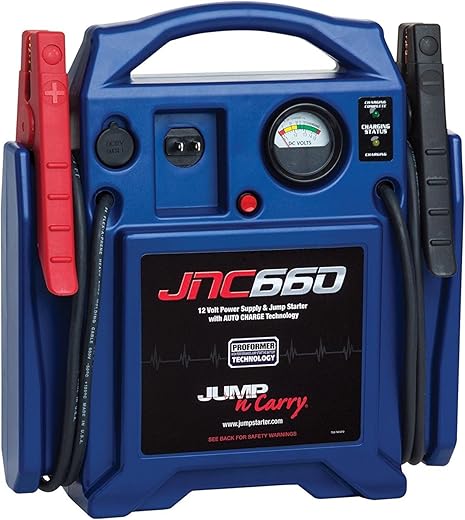
Clore Automotive Jump-N-Carry JNC660 1700 Peak Amp 12 Volt Jump Starter , Blue
Locate the vehicle battery terminals and identify positive (+) and negative (−). If the battery is inaccessible, consult the owner’s manual for recommended connection points.
Power OFF the jump box (if required) before connecting clamps. Attach the clamps firmly — for example, use a clean bolt on the engine block behind the alternator as a ground point. Listen for reverse-polarity alarms; if an alert sounds, stop immediately, recheck clamps, and correct polarity. Ensure clamps have clean, solid contact; if terminals are corroded, clean them with a wire brush before clamping.
Start the Engine Safely and Monitor Carefully
How long should you crank? Short, controlled bursts—more is not always better.Power ON the jump box following the manufacturer’s sequence. Attempt to start the vehicle using short cranking bursts—commonly 5–10 seconds—and release immediately; avoid extended cranking that can overheat the starter or jump box.
Wait 30–60 seconds between attempts to let the starter and jump box cool. Limit attempts per the manual, typically three total tries.
Monitor the jump box voltmeter or vehicle gauges. Expect approximately:
Try a practical pattern: crank 7 seconds, wait 45 seconds, repeat up to the manual limit. Stop immediately and disconnect if you smell burning, see smoke, or hear abnormal noises, and consult a professional.
Disconnect and Recharge the Jump Box Properly
Don’t rush the shutdown — there’s still current flowing even after the engine starts.Power OFF the jump box if required and confirm the vehicle runs stably for at least one minute. Remove clamps in the reverse order of connection: negative (ground) first, then positive. Avoid touching clamps together or letting them contact any metal surface during removal.
Store clamps in their holders and stow the unit in a dry, cool place away from direct sunlight. Recharge the jump box as soon as possible—most manufacturers recommend replenishing within 24 hours to prevent deep discharge and preserve battery life.
Document the event (date, ambient conditions, number of start attempts) if the unit records usage. Record a brief note—e.g., “started at −5°C; three attempts.” Note any unusual indicators—smoke, swelling, abnormal voltage readings—and schedule immediate inspection or disposal per the manual.
Maintain, Troubleshoot, and Dispose Responsibly
Neglected jump boxes are liabilities — treat yours like a first-aid kit: check it regularly.
Car Jump Starter, 12V Portable Battery Charger (up to 7.5L Gas&5.5L Diesel Engine) Auto Lithium Battery Booster 2000A 18000mAh Jump...
Perform routine checks every 1–3 months: verify state of charge, inspect cables and clamps for wear and corrosion, and test the unit’s start capability per the manual (e.g., attach to a low-load vehicle and attempt one start).
Dispose responsibly: follow local electronic-waste and battery regulations and never throw the jump box in household trash.
Safe Use Wrap-Up
A methodical, manufacturer-guided approach minimizes risk and extends equipment life: inspect, connect correctly, follow safe start procedures, recharge promptly, and maintain records to ensure reliable performance—when seconds really count, are you prepared?


Nice breakdown. One minor thing: the section on disposal could use vendor links or local recycling tips. Not everyone knows where to take lithium jump boxes for safe disposal.
Good point, Ethan. We kept it general to apply internationally, but adding a short list of disposal options (electronics recyclers, hazardous waste days, manufacturer take-back) would definitely help. We’ll consider adding links for common regions.
Most city websites have hazardous waste pages. If not, call the waste management department — they usually know where to bring battery packs.
Thanks for the suggestions — we’ll add manufacturer mail-back and local recycling center options in the next update.
Yeah, and some manufacturers offer mail-back programs. Might cost a small fee, but safe for sure.
This guide made me feel less scared about trying a jump box for the first time. The step about making connections in the correct order was especially clear. Still, I’d love a quick printable checklist — something you can keep in the glovebox.
Yes please make the checklist. I keep forgetting the exact clamp order since I rarely jump a car.
A printable checklist is a great idea! We’ll create a one-page checklist (inspect, position, connect + order, start & monitor, disconnect, recharge) you can print and keep in the glovebox.
Constructive note: the section on ‘Maintain, Troubleshoot, and Dispose’ felt a bit short. Maybe add a small periodic maintenance schedule (monthly check, recharge every 3 months, visual inspection). Also: safety around lithium batteries deserves a stronger emphasis.
Agree on stronger lithium safety wording, especially for puncture/fire risk and proper disposal.
Monthly visual checks + recharging every few months is what I do. Keeps the unit ready for winter emergencies.
Thanks, Samuel — good feedback. A periodic maintenance schedule is useful. We’ll expand the disposal and lithium-safety parts and add a recommended maintenance cadence.
Loved the Safe Use Wrap-Up — concise and to the point. Two tiny nitpicks: 1) add a reminder about wearing gloves/eye protection if you have them, and 2) maybe a sentence about hybrid/electric vehicles being different (do not jump with a standard jump box unless the manual explicitly allows).
Both excellent additions, Lena. We’ll add PPE as an optional safety reminder and include a clear warning about hybrids/EVs and consulting the vehicle manual.
Good catch on hybrids — a friend tried once and the shop said never again. Always read the car manual!
Yes, hybrids are special. Some have 12V systems but different servicing rules. Better safe than fried.
Funny story: I once forgot to turn the car off before connecting the jump box… everything worked out but the horn went berserk when I started it. Lesson learned. Guide should warn about turning accessories off before starting.
Agree on the strong warning. Even small electronics draw can affect the initial charge transfer.
Yikes! That’s a memorable one. We do recommend turning off lights, radio, and accessories before attempting a jump. We’ll make that callout more explicit in the ‘Start the Engine Safely’ section.
Thanks — I’ll send a short animated GIF idea for that warning if the admin wants it. Could be funny and educational.
Great guide — super practical. I liked the step-by-step on making connections in the correct order. Saved me from that awkward moment last winter when I almost mixed up the clamps. Quick question: how long should you wait after the engine starts before disconnecting? The guide mentions ‘monitor carefully’ but doesn’t give a time range.
I usually give it about 5 minutes if I can — depends on how cold it is. Cold weather = longer wait imo.
Good catch, Megan. Once the engine starts, let it run for 1–3 minutes to allow the alternator to charge the battery a bit, then disconnect following the reverse order of connections. If the battery was totally dead, consider driving for 15–30 minutes or letting the car idle to build a more stable charge.
Also agree with @Sam — cold batteries need more time. But keep an eye on dash lights and electronics; if something looks weird, shut it off and double-check connections.
I appreciated the ‘Position vehicle and jump box safely’ section. One thing I do: put the jump box on something non-conductive (cardboard or rubber mat) if the ground is wet. Might be over-cautious, but wet + electronics freaks me out.
Totally — I keep an old towel in the trunk for that exact reason. Also stops the unit from slipping around on sloped driveways.
Not overcautious at all — using a non-conductive surface reduces risk and is a smart habit. Good tip!
I liked the troubleshooting section. One tip that helped me: if the jump box clicks when trying to start, it could mean the unit has built-in protection reacting to a short. Unplug and inspect clamps for corrosion or a clipped cable. Fixed mine in two minutes.
Excellent practical tip, Grace. That clicking is often the protection circuit. Inspect clamps and wiring closely, and try again only after resolving any visible issue.
I had that once — turned out a clamp jaw wasn’t fully open and it kept slipping. Worth checking the simple stuff first.