

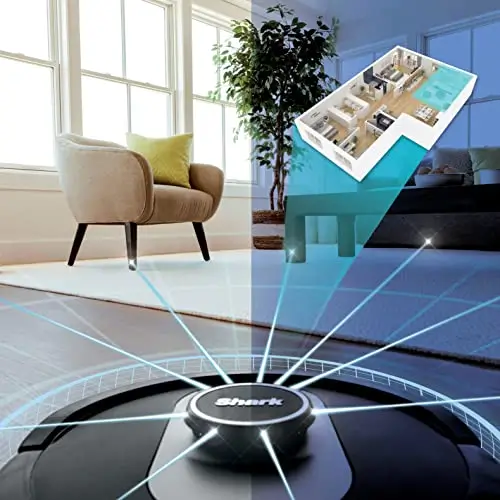
Powerful suction and smart mapping for pet-heavy homes—if you can tolerate the large self-empty base.
Tired of finding tufts of fur on the couch five minutes after you vacuum? If your home doubles as a pet hair museum (or you sneeze every time you walk in), the real pain is constant maintenance: tangled brushrolls, tiny gaps that never get cleaned, and emptying dustbins more often than you’d like.
The Shark RV2502AE AI Ultra aims to fix that with LiDAR-guided, methodical cleaning, strong suction, a self-cleaning brushroll, and an XL HEPA self-empty base that claims up to 60 days of hands-off debris collection. In this review I’ll look at how those features perform in real homes, what trade-offs to expect (hello, big base and premium price), and whether it’s worth the $469.95 for pet owners and allergy sufferers.

A powerful, methodical robot that combines strong suction with advanced LiDAR mapping to deliver reliable daily maintenance and deeper multi-pass cleans. The HEPA XL self-empty base and self-cleaning brushroll make it especially appealing for homes with pets or allergy concerns.
Overview
The Shark RV2502AE AI Ultra Robot is built to be a hands-off, high-performance floor-care partner. It combines Shark’s high suction power and self-cleaning brushroll with LiDAR-powered Precision Home Mapping and Matrix Clean Navigation that takes multiple, focused passes so dirt and debris aren’t left behind. The robot docks to an XL HEPA self-empty base that stores up to 60 days of collected debris while trapping allergens down to 0.3 microns.
What’s Included and First Impressions
Included in the box you get a ready-to-run robot that pairs to the self-empty base and comes with two side brushes and the required power accessories. The dock is larger than a standard charging pad because it contains a bagless collection chamber and HEPA filtration.
Design, Size, and Build Quality
The robot has a low-profile round form factor that fits under many sofas and cabinets, though the ML-sized base makes the entire clean-and-store footprint substantial. Build quality feels solid: the bumper is soft to avoid scuffs, the brushroll assembly is easy to access, and the materials are durable enough for routine household use.
Suction, Brush System, and Floor Coverage
Shark emphasizes suction and a self-cleaning brushroll designed to pull hair and fibers away from the roller instead of wrapping them. Combined with Matrix Clean Navigation the robot takes multiple passes in a grid over areas with more debris, which improves pickup vs. single-pass systems.
This model uses 360° LiDAR to quickly scan and build a precise map of your home, then refines that map with Precision Home Mapping for room-by-room control. Matrix Clean Navigation overlays a cleaning grid and will run multiple passes on dirtier zones so no spots are missed. Object avoidance is smart and relatively gentle — the unit detects obstacles and reroutes while keeping interactions to a minimum.
Self-Empty Base & Filtration Details
The XL self-empty base is a standout feature: it’s bagless yet uses a true HEPA system in the base to trap 99.97% of dust and allergens down to 0.3 microns. The big benefit is fewer base-empty chores — the base can hold up to 60 days of debris depending on your usage and household conditions.
| Feature | What it means for you |
|---|---|
| XL bagless base | Less frequent emptying — weeks to months between maintenance depending on home and pet level |
| True HEPA filtration | Traps fine particles and allergens at the base rather than re-releasing them |
| Self-empty cycle | Quick automatic transfer from robot bin to base chamber after each run |
Runtime, Recharge & Resume
With up to 120 minutes of runtime per charge, the robot can handle many mid-to-large homes on a single cycle. If it doesn’t finish, Recharge & Resume enables the robot to return to the dock, recharge, and then pick up where it left off using its saved map.
App Control, Voice Assistants, and Scheduling
The app gives room-level control, scheduling, and cleaning intensity options. Integration with Amazon Alexa and Google Assistant means you can start/stop cleans with voice commands. Precision mapping allows you to name rooms and tell the robot to clean specific zones or avoid areas.
Maintenance and Consumables
Easy-access maintenance points include the dust cup on the robot (auto-emptied between runs), replaceable HEPA components in the base, and the side brushes. The self-cleaning brushroll cuts down on manual detangling. Consumables you should monitor:
Ideal Use Cases and Who Should Buy It
This robot is aimed at owners who need more than just light pickup — think pet owners, busy households, and allergy-sensitive homes that benefit from frequent, automated cleaning and HEPA-level filtration. If you want minimal daily maintenance and an automated system that intelligently maps and deep-cleans priority areas, this fits the bill.
Real-World Tips for Best Performance
Technical Snapshot
Final Thoughts
If you want a robot vacuum that reduces routine chores and handles pet hair, repeated dirt hotspots, and allergen capture, this model is engineered to be a dependable, hands-off solution. The trade-offs are a larger base footprint and a higher price than entry-level robots, but you get advanced mapping, focused multi-pass cleaning, and HEPA-class containment that justify the premium for many households.


FAQ
Matrix Clean Navigation breaks your floor plan into a grid and makes multiple, targeted passes over areas with more dirt. Rather than a single random sweep, it focuses effort where debris is concentrated which improves overall pickup and reduces missed spots.
The self-cleaning brushroll and strong suction substantially reduce hair wrap compared with conventional brushrolls. While not completely immune to tangles, most pet owners find routine maintenance requirements are much lower and the vacuum handles daily shedding effectively.
Yes — the XL base stores a large volume of debris and uses HEPA filtration to keep allergens contained. Actual duration between manual emptying depends on pet level and household dirt, but many users will see several weeks to about two months of hands-off use.
LiDAR does not rely on visible light, so mapping and navigation remain accurate in low light or darkness. The robot can map and clean effectively at night without losing orientation.
Yes — it transitions between hard floors and low-to-medium pile carpets well. For multi-floor homes you’ll need to move the robot and dock to each level; the saved maps feature can store multiple floor layouts if the app supports it, enabling room-specific cleaning per floor.
Remove low-hanging cords, small rugs with fringes, and tiny obstacles in frequently cleaned zones. Use boundary settings in the app to exclude tight chair legs or areas where furniture gaps are too narrow for reliable passage.





Tried the Shark RV2502AE for a week and I’m impressed with how it handles my golden retriever’s fur. The self-empty base is a game changer — less daily maintenance for me.
Only gripe: at $469.95 it’s not cheap. But if you hate emptying dustbins every day, it might be worth it.
Totally agree on the self-empty. I used to come home to a full bin constantly. Do you notice any loss of suction after long runs?
Noah — not really, suction felt consistent. It did a couple of multi-pass cleans on my rug and picked up hair clumps fine.
Thanks for sharing, Emma — glad to hear it worked well with heavy shedding. For anyone wondering, the review notes a 120-minute battery life and the HEPA XL self-empty base, which helps justify the price for some households.
I’m kinda on the fence. Love the LiDAR mapping and obstacle avoidance — my house isn’t a straight line and the maps are neat.
But $470, plus the weird feeling of letting a robot roam alone in your home (lol),
plus replacement bags/filters down the road… makes me hesitate.
Would you recommend it for a two-cat household?
Also, is the brushroll really self-cleaning? I’ve been burned by ‘self-cleaning’ before.
Liam — valid points. The review calls out the self-cleaning brushroll as one of the strengths: it reduces hair wrap significantly compared with many competitors, though no brushroll is 100% maintenance-free. For two cats it should be a solid fit, especially with the HEPA XL base minimizing how often you touch collected hair.
I have two cats and the ‘self-cleaning’ claim largely checks out. I still manually remove long tangles every few weeks but it’s way less frequent than my old Roomba.
Thanks everyone — good to know it’s not total marketing fluff.
Replacement bags are a thing to consider. I stock a couple so I don’t run out — they last a bit depending on how much you run the robot.
One more note: the review rated it 8.9/10 for a reason — it balances strong suction, reliable mapping, and pet-friendly features. But if upfront cost or consumables worry you, factor that into your decision.
Bought this for my apartment with a small dog — love that it integrates with Alexa. Set it to run while I’m at work and come back to cleaner floors. Quiet enough for daytime runs.
Quick Q — do you hear it through walls in an apartment? My downstairs neighbor complained about another vacuum once.
Glad it’s working well for you, Sophia. The review notes voice control compatibility (Alexa/Google) as handy for that exact use case.
Does anyone know how easy the filter/bag replacements are? I’m allergic and want to avoid stirring up dust when changing parts.
I change mine quickly over a trash bag and the mess is minimal. Not perfect, but way better than emptying the robot bin every day.
Maya — the review highlights the HEPA XL self-empty base which reduces how often you handle dust. When you do replace bags/filters, many users reported the bag is fairly contained (less dust cloud than some others). Still, wearing a mask or doing it outdoors could help if you’re very sensitive.
Neutral take from me. The mapping is great but it occasionally gets stuck on weird edges — mine has trouble with a narrow rug fringe. Not a dealbreaker, but something to watch for.
Also the app is decent but I wish it had more manual zone customization.
Good tips — I’ll try a no-go zone for now.
App feedback is useful, Noah. The review mentioned robust LiDAR mapping but acknowledged occasional edge cases with fringes or low-clearance objects. Shark tends to update app features over time, so zone tools might improve.
I had the rug-fringe issue too — placing a small ramp or securing the fringe helped. Not ideal, but fixed it for me.
If it helps, you can set no-go zones in the app for problem spots. Not perfect, but saved me from repeated rescues.
Was hoping for a lower price from Shark. $469.95 feels premium — the suction and mapping are solid, but I can’t justify spending that much for a ‘convenience’ appliance.
Also, battery life claims (120 min) are optimistic depending on power mode. In max mode expect less. Just saying so folks don’t get sticker shock.
Pricey for sure, but for my allergy issues the HEPA and self-empty were decisive. It’s a personal value call.
I run it on standard mode most days and get decent runtime. If I need a deep clean I switch to max and accept the shorter session.
Fair assessment, Ethan. The review lists 120 minutes as the battery spec, but the real-world runtime varies with cleaning mode and surface type — common for robot vacuums.
Yeah I get that. Just playing devil’s advocate for folks who want bang-for-buck.
Good points all. The expert verdict in the review balanced the higher price against features targeted at pet owners and allergy sufferers — that’s the trade-off to consider.