Why lifecycle management matters for portable lithium jump starters
A single portable lithium jump starter can lose 30–40% of its usable capacity within two years under poor care, increasing replacement costs and safety risks. Many failures—cell aging, internal short circuits, BMS faults, and swollen packs—are predictable and preventable when users follow evidence-based practices.
This article condenses research and field data into practical guidance for consumers and fleet managers. You’ll get clear, actionable steps on charging, storage, temperature control, inspections, safe use, and end-of-life handling to maximize reliability, reduce costs, and minimize hazards.
Adopting simple habits—correct charge profiles, periodic diagnostics, ambient temperature limits, and responsible recycling—can extend service life by YEARS, improve readiness, and lower total cost of ownership for both individual users and commercial fleets significantly.
1
Understanding the device: components, ratings, and failure modes
A portable lithium jump starter is more than a battery in a box. Key parts:
Battery cells: typically lithium‑ion (high energy density) or, increasingly in commercial units, lithium‑iron‑phosphate (LiFePO4) for longer cycle life and thermal stability.
BMS (battery management system): cell balancing, over/under‑voltage cutoff, temperature sensing, and short‑circuit protection.
Boost/starting circuitry: high‑current MOSFETs, capacitors, and wiring that deliver the momentary surge.
Clamps/connectors, enclosure, and user interfaces: LED indicators, USB/12V ports, and status lights.
Example: the popular NOCO Boost Plus GB40 pairs a compact Li‑ion pack with a robust BMS and rated 1000A peak for many small engines.
Key specifications to read and compare
Capacity: Ah or Wh (e.g., 1.5 Ah ≈ 5–6 Wh for small packs); higher Wh = more reserve.
CCA equivalence: many manufacturers give a “CCA equivalent” — use this to match your vehicle’s cold‑start needs, but treat it as directional, not identical to SAE CCA tests.
SOC indicators and protection features: charge level LEDs, auto shutoff, reverse polarity, and overcurrent protection.
Quick tip: choose a starter whose peak/cranking amp rating equals or exceeds your vehicle’s CCA spec.
Common failure modes (and how fast they can show up)
Cell capacity fade: typical Li‑ion packs lose ~2–8% capacity per year under good care; poor conditions can accelerate this to 20–40% within two years.
Increased internal resistance: can double over the pack life, producing voltage sag and leaving you unable to deliver required starting current.
BMS component failures: temperature sensors or MOSFETs can fail from repeated high‑current cycles or surges, sometimes after only dozens of heavy starts.
Connector/clamp corrosion and mechanical damage: a corroded clamp can cause large voltage drop — a common field failure that’s easy to prevent with inspection.
Overcurrent, deep discharge, thermal stress: single severe overcurrent or repeated deep drains can cause immediate capacity loss or, in the worst case, thermal runaway.
Actionable checks: inspect clamps, measure open‑circuit voltage, and run a periodic start test under controlled conditions to confirm peak delivery.
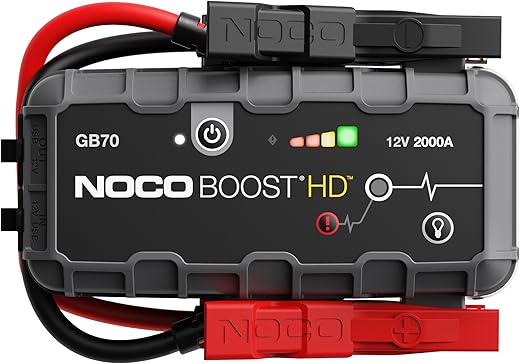
START DEAD BATTERIES — Instantly start dead batteries with 2000 amps of peak lithium power. Up to 40 starts per charge on engines up to 8.0L gas and 6.0L diesel.
ULTRASAFE ...
Two chemistries dominate portable jump starters: high‑energy lithium‑ion (NMC/NCA types used in many compact units) and lithium‑iron‑phosphate (LiFePO4) increasingly found in rugged/premium packs.
Typical longevity (approximate):
NMC/NCA: ~300–1,000 full cycles at 80% depth of discharge (DoD); calendar life commonly 3–8 years depending on use and storage.
LiFePO4: ~2,000–5,000 full cycles at 80% DoD; calendar life 8–15+ years in good conditions.
Thermal tolerance: LiFePO4 is more tolerant of high temperatures and abuse; NMC/NCA degrades faster above ~40°C.
Real-world example: compact consumer boosters that prioritize energy density (smaller size, higher Wh) often use NMC to save weight, while heavy‑duty units that advertise thousands of cycles typically use LiFePO4.
Key degradation mechanisms (what actually fails)
SEI growth: Solid‑electrolyte interphase thickens with cycling and heat, consuming active lithium and lowering capacity.
Lithium plating: Fast charging or charging at low temperatures deposits metallic lithium on the anode — permanent capacity loss and safety risk.
Electrode particle fracture: Repeated expansion/contraction (deep cycles/high C pulses) causes loss of electrical contact and increases resistance.
Electrolyte decomposition: Elevated temperatures accelerate solvent breakdown, gas generation, and impedance rise.
Separator aging: Oxidation or shrinkage reduces ion flow or can cause internal shorts.
How usage accelerates wear (data‑driven guidance)
Depth of discharge: shallower cycles dramatically increase cycle life — e.g., cycling at 20–30% DoD can multiply usable cycles versus 80–100% DoD.
C‑rates: sustained charge or discharge above ~1C significantly increases mechanical stress and SEI growth; high‑current pulses are tolerated briefly but repeated heavy cranking shortens life.
Temperature: chemical reaction rates roughly double per +10°C (Arrhenius behavior) — storing/operating at 45°C vs 25°C can cut calendar life by 50% or more.
Practical trade-offs and immediate tips
If you need compact size and occasional use, NMC packs work but expect shorter life.
For frequent use, thermal stress, or long service life, choose LiFePO4.
Ensure the BMS is rated for the required pulse current and includes temp compensation to reduce plating risk.
Next you’ll learn concrete charging practices that minimize these degradation modes and extend usable life.
3
Optimal charging practices to preserve capacity and safety
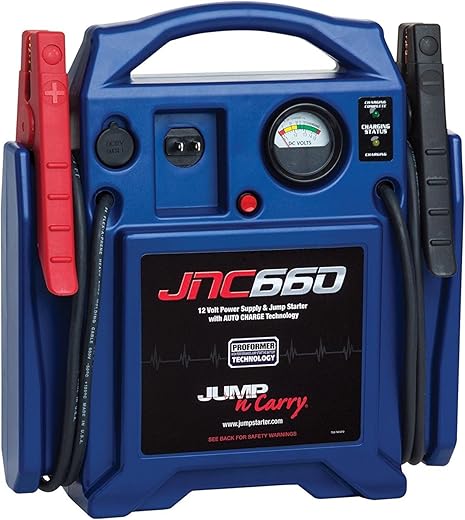
1,700 Peak Amps; 425 Cranking Amps
22Ah Clore PROFORMER Battery
46" Heavy-Duty #2 AWG Cables
Voltmeter provides charge status of onboard battery.
DC outlet to power 12 volt ...
Charge voltage, C‑rate, and avoiding 100% hang time
Charge targets differ by chemistry: for common NMC packs, full‑cell top voltages correspond to ~4.15–4.20 V/cell; LiFePO4 tops out near 3.60–3.65 V/cell. Running and storing packs at 80–90% state of charge (SoC) instead of 100% significantly slows calendar aging and lithium plating. Aim for a practical pack target of ~70–90% SoC for regular use and maintenance.
Occasional faster charging: up to 1C only if manufacturer specifies
Avoid sustained >1C charging unless pack explicitly rated for it
BMS vs external chargers: roles and what to use
The BMS enforces cell balance, over/under‑voltage protection, and current limits. Use a smart, chemistry‑aware charger (e.g., NOCO Genius series or any charger the manufacturer recommends) rather than a generic 12 V float charger. Trickle/float charging is acceptable at very low current for maintenance, but permanent float at high float voltages shortens Li‑ion life.
Maintenance charging routines (practical how‑to)
New unit conditioning: on receipt, do one controlled charge to ~80–90% at 0.2–0.5C and let the pack rest 24 hours to let the BMS balance cells.
Storage intervals:
Stored ~50% SoC at 20°C: check/maintain every 3 months.
Stored >30°C or >60% SoC: check monthly.
If used frequently, top up to ~80–90% after heavy use rather than 100% every time.
Signs a cell imbalance or charger problem
Cell imbalance indicators that need professional service:
Pack takes unusually long to reach voltage cut‑off or BMS repeatedly triggers balancing.
Noticeable capacity drop or one cell voltage >50–100 mV different from others at rest.
BMS errors, repeated cutoff during charge, or swelling/heat.
Safety red flags
Never charge with visibly damaged chargers, cables, or a pack after a hard impact.
Charge only in a well‑ventilated area away from flammable material and direct sunlight.
If you suspect internal damage (noise, smell, heat, bulging), stop charging and consult the manufacturer or a certified battery service.
4
Storage, temperature control, and environmental protection
Newly Upgraded All-in-one Jump Starter and Air Compressor - Built-in 24000 mAh battery and a peak current of 4000A, it can start a completely dead 12V car battery (up to 10L gas ...
Heat: accelerating aging — rule of thumb: every 10°C above ~25°C significantly increases calendar fade.
Recommended storage: 15–25°C (59–77°F). Short‑term operating window: -20°C to 50°C discharge (check manufacturer); charging is usually restricted to 0–45°C.
Actions during extremes:
Cold: warm the pack to >0°C before charging; keep inside a jacket or insulated case for roadside use.
Heat: avoid direct sun or hot trunks; move to shade/AC and do NOT charge in >45°C conditions.
Humidity, corrosion, and ingress protection
Moisture and salts corrode terminals and electronics.
Aim for <60% relative humidity in storage; use silica gel packs in cases.
Apply a thin film of dielectric grease on metal terminals to inhibit corrosion.
Choose devices/cases with IP ratings: IP54 minimum for fieldwork; IP65–IP67 preferred for wet environments.
Product examples: store jump starters in a waterproof hard case (Pelican 1200 or similar) with foam insert and desiccant.
Mounting, transport, and vibration
Vibration and shock damage cells, connectors, and BMS boards.
Secure mounting: use padded mounts or foam-lined cases; avoid loose cables that tug.
During transport: disconnect and stow in dedicated compartment; do not clamp to chassis without rubber isolators.
For heavy use vehicles, pick models with robust housings and automotive‑grade connectors.
Real-world note: technicians who stowed a jump starter in a glovebox saw earlier failure from condensation and vibration — moving it to a sealed Pelican case and 50% SoC extended reliable readiness.
5
Routine maintenance, diagnostics, and preventive care
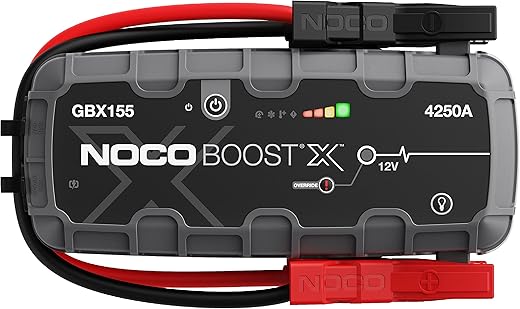
X FOR EXTREME — A new class of lithium jump starters. Rated at 4,250 amps for powerful starts on gas engines up to 10.0L and diesel engines up to 8.0L - built for extreme ...
WOLFBOX 4000A Jump Starter with 160PSI Air Compressor, 12V Car Battery Booster, 65W Fast Charge, 24000mAh Portable Tire Inflator, LED Display for 10L Gas &...
NOCO Boost X GBX155: 4250A UltraSafe Jump Starter – 12V Lithium Battery Booster Pack, Portable Jump Box, Power Bank & Jumper Cables - for 10.0L Gas and 8.0L...
Always treat portable lithium jump starters as safety equipment, not toys. Before every use:
Visually inspect clamps, cables, case, vents, and indicator LEDs for damage or swelling.
Confirm unit charge level and that the BMS reports “ready” (no fault).
Turn off vehicle accessories and remove jewelry.
Safe clamp sequence (minimizes sparks):
Attach red (positive) clamp to the vehicle battery’s positive terminal.
Attach black (negative) clamp to a clean, unpainted chassis ground at least 30 cm from the battery.
Power on the jump starter, start engine, then remove clamps in reverse order: black first, red last, and power off the unit.
Limits to avoid overheating and BMS lockouts:
Cranking: 3–5 attempts of 5–15 seconds each, with 2–5 minutes rest between attempts.
If no start after cumulative attempts, allow the starter to cool (15–30 minutes) and investigate — repeated abuse accelerates degradation and may trip thermal cutouts.
Rapid case swelling, hissing or popping, acrid chemical odor, visible smoke, or surface temperature rapidly exceeding 60°C. Evacuate area and call emergency services if fire occurs.
Practical troubleshooting (step‑by‑step)
Unit won’t power on:
Check OCV with a multimeter; if <2.5 V/cell equivalent, BMS may lockout. Charge with manufacturer charger for several hours.
Inspect fuse, cable continuity, and charger LED behavior (refer to manual).
Insufficient cranking current:
Measure OCV under no-load and under crank; high voltage sag or IR increase suggests reduced capacity or high internal resistance.
Inspect clamps for high-resistance connections; try a different starter or known-good battery to isolate starter vs vehicle starter problem.
False fault indicators / reduced runtime:
Reset BMS by disconnecting and charging, update firmware if available; if runtime is down >20%, schedule professional capacity testing (Cadex, Midtronics).
Replace if IR doubled or capacity loss exceeds fleet thresholds.
Responsible end‑of‑life handling
Decommissioning steps:
Follow manufacturer procedure: record serial, perform final visual and voltage checks, discharge or set to storage SOC per vendor guidance.
Insulate terminals, place in non‑conductive packaging, and label as spent lithium‑ion batteries.
Transport and documentation:
Use certified hazardous‑materials shippers and compliant packaging; many recyclers/request carriers require lower SOC (consult current IATA/49 CFR rules).
For fleets, maintain chain‑of‑custody: serial number, test data, decommission date, and recycler receipt (R2 or e‑Stewards preferred).
Minimize environmental impact: never landfill—use qualified recyclers to recover materials and avoid safety and regulatory risks.
Now, with operational safety and end‑of‑life practices covered, proceed to the article’s concluding guidance.
Maximizing lifespan through disciplined care
Choose the right chemistry and capacity for your usage profile, favoring cells and BMS features matched to cranking power and cycle life. Pair that choice with disciplined charging: use appropriate chargers, avoid prolonged full charges or deep discharges, and monitor state of health periodically. Store at recommended charge and temperature ranges, protect from moisture and mechanical stress, and run routine diagnostics (voltage, internal resistance, connector integrity) to catch degradation early.
Replace or recycle units responsibly before failures become safety risks. Consistent, data-driven maintenance and safe operation extend reliability, improve performance, and reduce total cost of ownership—make disciplined care the standard.
Love the practical tips, especially about temperature storage limits. A couple of practical notes from my experience:
– Don’t store the unit in direct sunlight (seems obvious but my old one sat under a window for months).
– If you live somewhere cold, bring the jumper indoors before using it, let it warm up to room temp — cold reduces output.
– I started logging charge cycles on my phone (yep, nerdy) and noticed performance drop after ~300 cycles.
Would be cool if the article included recommended intervals for diagnostic checks (multimeter readings, LED status tests, etc.).
Thanks Meghan — great practical tips. We intentionally avoided overly prescriptive numbers because devices vary, but recommending monthly visual + voltage checks and a full diagnostic every 6–12 months is reasonable for most users.
If anyone wants a simple diagnostic routine: 1) Visual inspection for swelling/damage, 2) Measure open-circuit voltage, 3) Attempt a controlled short charge/discharge and monitor temperature/behavior, 4) Update storage charge if needed.
Logging cycles is such a good idea. I just keep a sticky note on the unit, haha. For diagnostics I usually check open-circuit voltage and then do a short load test if I suspect issues.
Good article. Quick nitpick: the bit about ‘fully discharging occasionally’ made me pause — isn’t full discharge generally bad for lithium? Could use a clearer sentence there to avoid confusion.
You’re right to flag that, Tom. The intent was to contrast lithium chemistries with older NiMH/NiCd practices — for lithium, avoid deep discharges when possible. We’ll update the wording to make that explicit. Thanks!
Nice overview. The section on failure modes was especially useful — helps me understand whether a dead unit is the battery or some electronics. One thing I wish the article had: a quick checklist for what to do immediately after a jump-start (cooldown time, recharge steps, etc.).
Great read — I appreciated the deep dive into charging habits.
I never realized that leaving a jump starter at 100% all the time is actually worse than keeping it around 50-80%.
I’ve been storing mine fully charged in the trunk (oops) and noticed capacity drop over a couple years.
Question: for infrequent use (once every few months), is it better to remove the battery if possible or just keep it at ~60% and check monthly?
Agree with admin. I keep mine at ~50% on a shelf in the garage, not the trunk. Also use a small smart charger if I remember — that helped mine last longer.
Good question, Laura — for most sealed portable lithium jump starters you can’t remove the pack, so periodic top-ups to ~60% and storing in a cool place is the best practical approach. Monthly checks and a short maintenance charge every 2–3 months work well.


 Amazon.com


Love the practical tips, especially about temperature storage limits. A couple of practical notes from my experience:
– Don’t store the unit in direct sunlight (seems obvious but my old one sat under a window for months).
– If you live somewhere cold, bring the jumper indoors before using it, let it warm up to room temp — cold reduces output.
– I started logging charge cycles on my phone (yep, nerdy) and noticed performance drop after ~300 cycles.
Would be cool if the article included recommended intervals for diagnostic checks (multimeter readings, LED status tests, etc.).
Thanks Meghan — great practical tips. We intentionally avoided overly prescriptive numbers because devices vary, but recommending monthly visual + voltage checks and a full diagnostic every 6–12 months is reasonable for most users.
If anyone wants a simple diagnostic routine: 1) Visual inspection for swelling/damage, 2) Measure open-circuit voltage, 3) Attempt a controlled short charge/discharge and monitor temperature/behavior, 4) Update storage charge if needed.
Diagnostic intervals depend on use. If you’re a weekend-only driver, once a quarter is fine. If you use it a lot for road trips, monthly is better.
Logging cycles is such a good idea. I just keep a sticky note on the unit, haha. For diagnostics I usually check open-circuit voltage and then do a short load test if I suspect issues.
Good article. Quick nitpick: the bit about ‘fully discharging occasionally’ made me pause — isn’t full discharge generally bad for lithium? Could use a clearer sentence there to avoid confusion.
You’re right to flag that, Tom. The intent was to contrast lithium chemistries with older NiMH/NiCd practices — for lithium, avoid deep discharges when possible. We’ll update the wording to make that explicit. Thanks!
Nice overview. The section on failure modes was especially useful — helps me understand whether a dead unit is the battery or some electronics. One thing I wish the article had: a quick checklist for what to do immediately after a jump-start (cooldown time, recharge steps, etc.).
Great read — I appreciated the deep dive into charging habits.
I never realized that leaving a jump starter at 100% all the time is actually worse than keeping it around 50-80%.
I’ve been storing mine fully charged in the trunk (oops) and noticed capacity drop over a couple years.
Question: for infrequent use (once every few months), is it better to remove the battery if possible or just keep it at ~60% and check monthly?
Agree with admin. I keep mine at ~50% on a shelf in the garage, not the trunk. Also use a small smart charger if I remember — that helped mine last longer.
Good question, Laura — for most sealed portable lithium jump starters you can’t remove the pack, so periodic top-ups to ~60% and storing in a cool place is the best practical approach. Monthly checks and a short maintenance charge every 2–3 months work well.