



Data-Backed Safe Jump-Starting
I understand this is stressful; follow these concise, DATA‑DRIVEN steps to jump-start safely. We explain battery basics, correct clamp order, and risk controls so you can act quickly and confidently while avoiding sparks, damage, or injury nearby, day or night.
What You Need Before You Begin
Assess the Scene and Battery Condition
Is it a dead battery or something worse? Quick checks that save time and hazard.
NOCO Boost GB70: 2000A UltraSafe Jump Starter – 12V Lithium Battery Booster Pack, Portable Jump Box, Power Bank & Jumper...
 Amazon.com
Inspect the area and battery before touching cables.
Inspect the battery and engine bay for cracked cases, bulging, leaking acid, or heavy corrosion (white/green powder). For example, if the case is swollen or you see a liquid film, do not jump-start.
Smell for sulfur (rotten-egg); ventilate and move people back if detected and call roadside assistance immediately.
Measure the resting voltage with a multimeter if available. Expect about 12.6 V = full, <12.4 V = discharged, and <11.5 V or frozen cells = professional handling required.
Confirm both vehicles are off, in Park (or Neutral for manuals), with parking brakes set and keys/fobs removed.
Check battery date and model; replace if older than about four to five years or if performance has declined. For modern cars with complex ECUs, consult the owner’s manual for manufacturer-specific jump-start steps to avoid electronic damage.
Prioritize safety: if any high‑risk signs appear or you are unsure, wait for trained help rather than risking sparks, burns, or system damage.
Position Vehicles and Prepare the Area
Location matters — a few inches and the right angle reduce risks more than you might expect.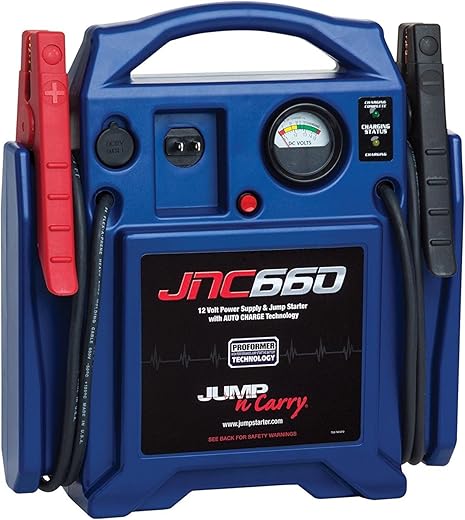
Clore Automotive Jump-N-Carry JNC660 1700 Peak Amp 12 Volt Jump Starter , Blue
Amazon.com
Park the donor vehicle so batteries are close but the vehicles do not touch; leave about two to three feet (0.6–0.9 m) clearance for fender access. Align vehicles straight for easy cable reach and engine accessibility.
Engage both parking brakes and place transmissions in Park (or Neutral for manuals). Turn off all electronics, climate control, stereo, and lights to eliminate electrical loads during the boost.
Prepare and check:
Connect the Jumper Cables in the Correct Order
One wrong clamp and sparks may fly — literally. Follow the order every time.
WOLFBOX 4000A Jump Starter with 160PSI Air Compressor, 12V Car Battery Booster, 65W Fast Charge, 24000mAh Portable Tire Inflator, LED...
Amazon.com
Identify positive (+) and negative (–) terminals on both batteries and confirm cable colors. Wear eye protection and avoid leaning over the battery.
- Attach the red clamp to the dead battery’s positive (+) terminal. Ensure a clean metal-to-metal contact.
- Attach the other red clamp to the donor battery’s positive (+) terminal. Firmly secure the clamp.
- Attach the black clamp to the donor battery’s negative (–) terminal. Use a solid contact point.
- Attach the final black clamp to an unpainted metal engine block or chassis ground on the dead vehicle—well away from the battery and fuel lines. Do not connect this clamp to the dead battery negative terminal if battery condition is unknown.
A solid, clean connection reduces resistance and heat and improves starting reliability measurably.
Start Engines and Monitor Voltage/Response
Don’t just crank—watch the numbers. What you monitor determines success.
NOCO Boost X GBX155: 4250A UltraSafe Jump Starter – 12V Lithium Battery Booster Pack, Portable Jump Box, Power Bank &...
Amazon.com
Start the donor vehicle and let it idle for 2–3 minutes to transfer surface charge and allow the alternator to stabilize. Increase throttle slightly to 1,500–2,000 rpm if safe to raise alternator output (e.g., a quick blip to 1,700 rpm on a cold morning), but avoid high revs.
Attempt to start the dead vehicle. Limit each crank to 10–15 seconds and wait 30–60 seconds between attempts to prevent starter overheating. Stop after three unsuccessful attempts and reassess.
Observe the instrument cluster and, if available, attach a multimeter to the dead battery terminals:
Keep both engines running once started. Let the restarted vehicle idle for several minutes or drive 15–20 minutes to recharge the battery. Monitor for abnormal noises, smoke, or dashboard warning lights constantly.
Disconnect Cables Safely and in Reverse Order
Disconnecting is as critical as connecting — one slip can undo your careful work.Keep both engines running and disconnect in the exact reverse order of connection. Remove clamps deliberately and steadily to avoid sparks.
Prevent sparks: do not let clamps touch each other or bare metal while any clamp is still connected. Stow cables clear of hot surfaces, belts, fans, and other moving parts. Power down portable jump starters per manufacturer guidance before removing clamps (for example, flip the unit off and disconnect any mode switches).
Watch the dashboard for warning lights, listen for unusual noises, and monitor engine behavior immediately after removal. Use a multimeter a few minutes later; a healthy charging system reads about 13–14.5 V while idling. If voltage falls quickly or the engine stalls, assume battery or alternator trouble—drive slowly to a repair shop or call a tow. Inspect terminals, tighten as needed, and drive at least twenty minutes or arrange professional load testing.
When Not to Jump-Start and Alternatives
Sometimes the safest option is NOT to try — know when to walk away or call a pro. Recognize dangerous battery signs and stop immediately. Do not attempt a boost if the battery case is cracked, bulging, leaking, emits a strong sulfur (rotten-egg) odor, or is visibly frozen—these can rupture or ignite.
Avoid boosting hybrid, plug-in, or electric vehicles unless the manufacturer explicitly permits it; high‑voltage systems can kill or cause severe burns.
Stop and call a technician if heavy corrosion prevents a secure clamp connection or if wiring or fuses near the battery show visible damage. If you follow correct procedure and the car still won’t start repeatedly, suspect a failed starter, bad wiring, or alternator—not just a drained battery.
Use safe alternatives:
Ask professionals for a load test and alternator diagnostics; have battery age, part numbers, and maintenance history ready for quicker repair decisions.
Finish Safely and Verify System Health
Following these ordered, data‑informed steps minimizes risk and improves success. After disconnecting, verify battery voltage, charging system warnings, repeat-start reliability. If measurements remain low or warnings persist, stop, seek professional diagnostics to protect vehicle and occupants. Ready to prioritize safety?


Real experience: I once connected cables in the wrong order and the other car’s dashboard fried (long story). Ever since, I follow the guide religiously.
Also curious if anyone’s tried the “start donor car, rev to 2000 rpm” trick vs just letting it idle? Data or personal anecdotes welcome!
Sorry to hear about the fried dashboard — incorrect connections can cause voltage spikes. About revving: a slightly higher RPM increases alternator output and can help charge faster, but don’t overdo it. 1500-2000 rpm for a minute is typically sufficient.
I’ve always revved to ~1800 for 30-60s after connecting and it helped on older cars. Newer cars with smart alternators sometimes behave differently, so be cautious.
If the donor car is a small car and the revs make the donor feel unstable, don’t rev too hard — safety first.
Neutral take: solid steps but felt a bit long for a quick roadside scenario. A TL;DR checklist printable card would be awesome to keep in the car.
This is one of the better practical guides out there. A few long-form thoughts:
– The ‘assess battery condition’ section could use a simple checklist: visual damage? corrosion? voltage reading? age of battery? That would help people triage faster.
– For the cable order, maybe include a tiny reminder to make sure clamps don’t touch each other once everything’s connected. Tiny sparks are scary af.
– Alternatives section: mention calling your insurance or roadside service — sometimes waiting for a pro is way cheaper than risking electrical damage.
Also, tiny anecdote: I once tried to jump-start a hybrid (facepalm). Not the smartest move — hybrids have specific procedures. People, if your car is weird, google the model first!
Yes hybrids are a whole other beast. My cousin’s Prius has a maintenance disconnect point — you need the manual.
Thanks, Hannah — excellent suggestions. We’ll add a quick triage checklist and a clearer warning about hybrids/EVs needing model-specific procedures.
I agree on triage checklist — saved me when my battery died mid-roadtrip and I had to decide to jump or pay for a tow.
Clamps touching is the universal fail moment. Also, watch out for cheap cables that heat up — gauge matters.
One-line PSA: if your battery is bulging or leaking — do NOT jump it. Toss the cables and call for help. Learned that watching a YouTube fail compilation lol.
Absolutely. Bulging, leaking, or cracked batteries are unsafe to jump — disposal and replacement is the right call.
Couple practical misc notes: secure loose clothing/hair, keep kids and pets away, and consider leaving the dead car on for a few minutes after starting to let the alternator stabilize. Small things but they matter.
All solid safety reminders, Daniel. Letting the car run for a few minutes helps recharge the battery and ensures the alternator is working properly.
Don’t forget to turn off accessories (radio, A/C) on both cars before trying to start. Saves a lot of headaches.
Minor nit: the guide recommends connecting the negative clamp to an unpainted metal surface away from the battery. Cool, but maybe include examples (strut tower, engine block). Newbies need specifics!
Good point, Tom. Examples like the engine block, a suspension strut tower, or an exposed bolt on the chassis are helpful — just avoid moving parts and painted surfaces.
Wow, this actually breaks down the why behind each step instead of just telling you “do X.” A couple of longer thoughts:
1) Assessing the scene: yes, don’t stand in front of the battery — never realized how dangerous that is until my cousin’s battery vented once.
2) Positioning cars: I like that you mentioned 30-60 seconds of charge time before trying to start — gives the alternator/jump battery a chance to stabilize.
3) Alternatives: shoutout to portable jump packs. Data-wise, do we have an idea how often a jump pack fails compared to another car?
Also — tiny typo in section 5, “Disconnect Cables Safely and in Reverse Oder” (should be Order).
Thanks for the note about standing in front of the battery — I always stood over it putting cables on like an idiot. Changing my ways now!
Great catch on the typo, Aisha — fixed, thanks! Regarding jump packs: most modern lithium jump packs are reliable, but their cold-weather performance can degrade. They generally have lower failure rates than relying on a random passerby if kept charged, but do check manufacturer specs.
About the 30-60s: depends on cables too. Thin, old cables deliver less current so sometimes you need more time. heavier gauge = faster top-up.
I’ve used a $60 jump pack for two years — never failed once. But left it in a freezing car overnight once and it lost about half its charge. Keep them warm when possible.
Short and useful. Loved the step-by-step order for cable connection — that’s the part people mess up most.